The 30-Second Summary
The official average price of new-build homes in Montenegro was €2,557 per m² in the second quarter of 2026 (MONSTAT, preliminary): €2,838 in the coastal region and €2,510 in Podgorica. In 2022 the national average was €1,339, a rise of about 91% in four years. Small flats near the sea are listed higher: on Fijaka on 23 September 2026, asking prices were €3,300–4,400 per m², with coastal studios from about €90,000 and one-bedroom flats from €100,000–150,000.
The official price per square metre
Montenegro's statistics office, MONSTAT, publishes the average price per square metre of new-build homes. Second quarter of 2026, preliminary:
| Area | New-build average, €/m² |
| Montenegro as a whole | 2,557 |
| Podgorica | 2,510 |
| Coastal region (Bar, Budva, Herceg Novi, Kotor, Tivat, Ulcinj) | 2,838 |
| Central region (Cetinje, Danilovgrad, Nikšić, Tuzi, Zeta) | 2,131 |
| Northern region | 2,145 |
Source: MONSTAT, new-build prices. Over four years the national average rose from 1,339 euros in 2022 to 2,557 euros, about 91%.
Three clarifications without which these figures are easy to misread:
- Apart from Podgorica, these are regions, not towns. There is no separate official price for Budva, Kotor or Tivat: they are all part of the coastal region average.
- Only new-builds are counted, those sold in the quarter, as reported by developers. The resale market is not in these statistics.
- "By the sea" in the official data means the coastal region as a whole, where expensive and more affordable municipalities sit side by side.
What real listings show
The official average does not answer the question of what a one-bedroom flat by the sea costs. Listings do. These are the prices sellers gave on Fijaka on 23 September 2026:
| Where | What | Price | Area | Per m² |
| Budva | Studio | 100,000 € | 23 m² | about 4,350 € |
| Kotor, Kavač | Studio | 90,000 € | 21 m² | about 4,290 € |
| Budva, Podkošljun | 1-bedroom | 150,000 € | 44 m² | about 3,410 € |
| Herceg Novi, Djenovići | Sea-view apartment | 245,000 € | 75 m² | about 3,270 € |
| Budva, Bečići | Sea-view studio | 95,000 € | not given | no data |
| Budva, Bečići | 1-bedroom with pool | 100,000 € | not given | no data |
These are asking prices, not sale prices, and the sample is small; we do not call it an index. But it shows the main point: small flats by the sea are listed well above the official coastal region average, at 3,300 to 4,400 euros per square metre. In these examples a studio in the coastal municipalities starts at about 90,000 euros, a one-bedroom at 100,000 to 150,000.
Current offers are on the Montenegro real estate listings and the Budva real estate page.
The Montenegrin Property Market — 2026 Outlook
Start with the numbers. According to Montenegro's national statistics office, MONSTAT, the national average for new-build homes was €1,339/m² in 2022, €1,532 in 2023, €1,844 in 2024 and €2,200 in 2025, reaching €2,557/m² in the second quarter of 2026 (preliminary) — about 91% in four years. Three demand waves stacked on top of each other: post-pandemic European holiday buyers, the 2022 Russian and Ukrainian relocation, and a steady inflow of Turkish, Israeli and Western European investors over the last 24 months.
Foreign demand is structurally embedded. Roughly 40% of all residential transactions in coastal Montenegro now involve a non-Montenegrin buyer (Central Bank of Montenegro, 2025). The largest national groups by volume: Russian and Ukrainian (combined ~30%), Serbian, German, British, Turkish and Israeli — in that order.
Four reasons foreign capital keeps flowing into Montenegro:
EU candidate status. Montenegro is the most advanced country in the EU's enlargement pipeline. The European Commission has set 2028 as a working target for accession. EU membership would open Schengen mobility and the single market — a structural lift for property values that buyers are pricing in early.
Euro-denominated assets. Montenegro uses the euro despite not being in the eurozone. Property is bought, held and sold in euros — no FX layer for European buyers, and a hard-currency hedge for buyers from soft-currency economies.
Low ownership costs. Annual property tax sits in a 0.25%–1% band of assessed value for standard residential property (special categories — vacant secondary tourist units, illegally built structures, uncultivated agricultural land — can carry higher rates). Rental income is taxed at a flat 15% personal income tax, plus a municipal surtax of 13–15% (15% in Podgorica and Cetinje), bringing the effective rate to roughly 17%. Compare this to the layered ENFIA + income tax burden in Greece or Italy's IMU regime.
Residence by investment. A €150,000 property qualifies the owner for renewable temporary residence under the January 2026 framework — one of the lowest thresholds in Europe.
City by City: Montenegro's Local Property Markets
Note: apart from Podgorica, MONSTAT does not publish town-level prices; there is no official price per m² for Budva, Kotor or Tivat. The town notes below describe each local market; current official figures and real asking prices are in the tables above.
Budva
The busiest stretch of the Montenegrin coast. Old Town walls, Bečići and Slovenska Plaža beaches, a nightlife economy that runs from June to mid-September, and a long-term rental market that keeps occupancy through the winter. Budva is the only Montenegrin coastal city where year-round rental yield is a realistic underwriting case rather than a sales pitch.
Studio apartments of 35–45 m² near the Old Town start at €110,000–140,000. One-bedrooms in Bečići or Slovenska Plaža run €130,000–180,000. Penthouses with Sveti Stefan views cross €1M. For an investor who wants a property they can rent out professionally and use personally a few weeks a year, Budva is the most defensible choice.
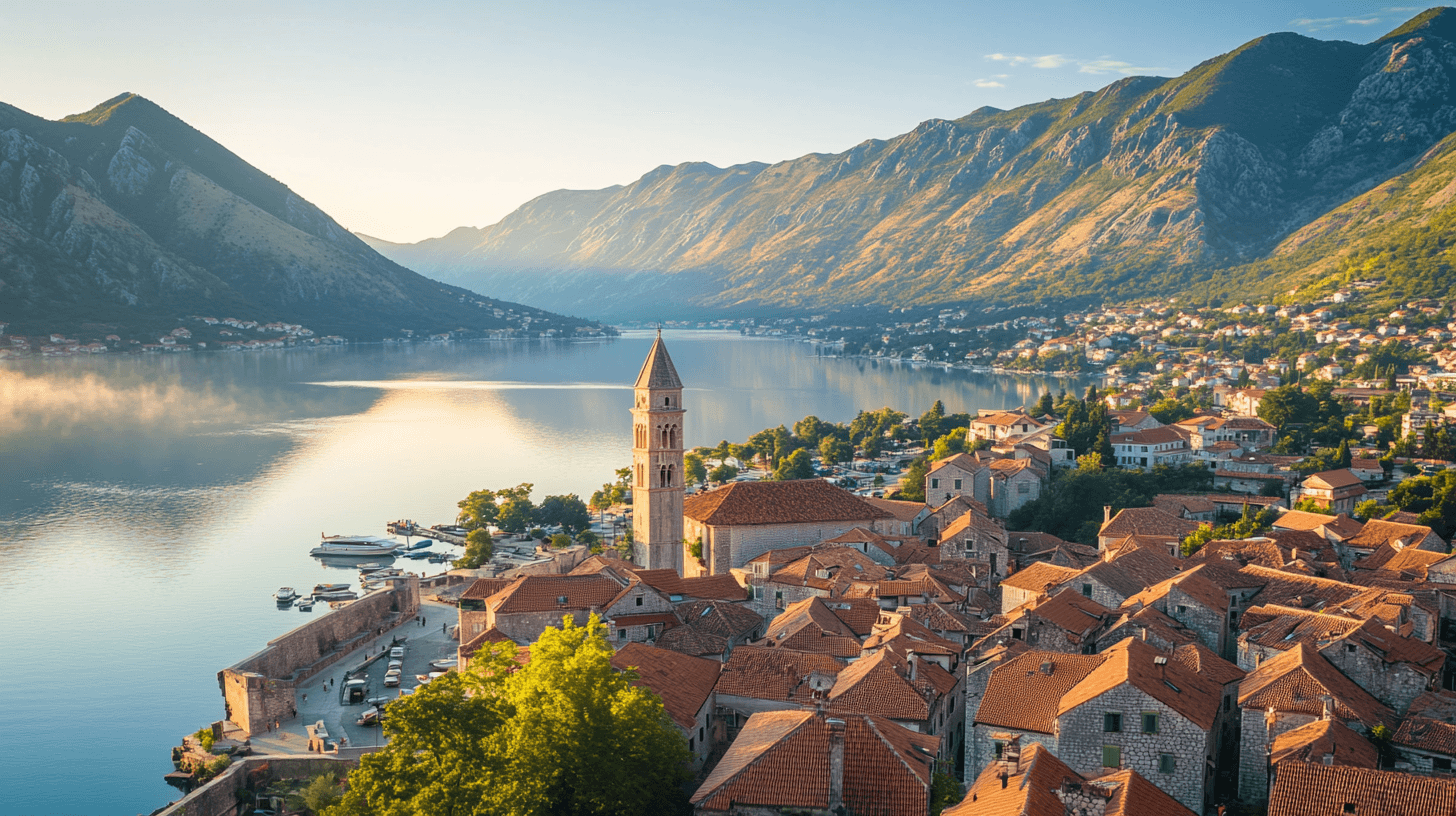
Kotor (UNESCO Scarcity)
The Bay of Kotor is a UNESCO World Heritage site. New construction is structurally constrained — building permits inside the protected zone are nearly impossible to obtain. That artificial scarcity has pushed prices up 8–12% per year. Restored stone houses inside the Old Town start at €600,000 and reach €2M for fully renovated waterfront properties.
The realistic market for non-trophy buyers is the surrounding villages — Dobrota, Prčanj, Muo, Stoliv. One-bedrooms in those areas trade at €150,000–250,000. Buyers should understand Kotor's value proposition clearly: this is a capital appreciation play, not a yield play. Rental returns are modest; the bet is on the scarcity premium compounding.
Tivat / Porto Montenegro (Ultra-Luxury)
The conversion of a former Yugoslav naval base into one of the world's leading superyacht marinas remade Tivat. Inside Porto Montenegro, one-bedrooms start at €180,000–300,000 and marina-front penthouses reach €2–5M. Lustica Bay and Luštica Marina occupy a similar tier.
Tivat is not a typical coastal investment — it's a wealth-preservation asset class. Roughly 70% of buyers are foreign, net rental yields are modest at 3–4%, but liquidity and price stability are unmatched anywhere on the Montenegrin coast.
Herceg Novi
Austro-Hungarian villa architecture climbing terraced hillsides toward the sea. The buyer profile skews older Western European — Germans, Austrians, Scandinavians looking for a quiet retirement coast. Substantially less seasonal noise than Budva.
One-bedrooms run €75,000–110,000, sea-view two-bedrooms €130,000–180,000. The right city for buyers who want coastal exposure without paying Budva pricing and without going as far south as Bar.
Bar
The most affordable coastal city in Montenegro. Functions as a port-rail-airport node, with the Bar–Belgrade rail and Tivat airport (45 minutes by road) integrating it well into the regional transport network. Sutomore, Šušanj and Pristan are the most active sub-markets.
New-build one-bedrooms trade at €55,000–90,000 — entry-level coastal property at prices unimaginable on the Budva or Tivat side. Seasonal yields are below Budva, but the long-term rental pool is deep and growing.
Podgorica
The capital. No coast, but the deepest long-term rental market in the country. The university, government ministries, foreign embassies and a growing service-sector economy create stable tenant demand. Net annual yields run 6–8% with minimal seasonality.
City-center one-bedrooms cost €65,000–95,000. Premium districts like Preko Morače and City Kvart sit at €100,000–140,000. For a passive-income investor without coastal nostalgia, Podgorica delivers far more predictable cash flow than any vacation property.
Ulcinj
Montenegro's southern tip, on the Albanian border, predominantly ethnically Albanian. Velika Plaža is the country's longest beach at 12 km. Ulcinj has not yet caught the Budva–Tivat wave — pricing reflects what Bar looked like five years ago.
That gap is both the risk and the opportunity. New-build one-bedrooms start at €50,000–80,000. The boutique tourism economy around Ada Bojana and the growing kitesurfing scene are the structural drivers most likely to lift prices over the next 5–7 years.
New Construction vs. Resale
New construction. €2,500–3,500/m² on the coast. VAT (21%) is included in the headline price, and the end buyer is exempt from paying it separately. A property with an issued upotrebna dozvola (use permit) carries no completion risk, registers faster at the cadastre, and comes with statutory warranty. Off-plan purchases sometimes offer developer financing — typically 30% down and the balance at handover — but this is where due diligence matters most. Confirm whether payments go to escrow or directly to the developer's account.
Resale. 20–40% cheaper than new construction. The natural choice for budget-constrained buyers, but legal review is non-negotiable. Common issues: undischarged mortgages, cadastral boundaries that don't match physical reality, missing inheritance consents from co-heirs, absent use permits. The single most expensive mistake I see foreign buyers make: signing a preliminary contract for €800–1,200 in notary fees before legal due diligence, then discovering an unresolvable defect that voids the deal.
Practical rule. With a coastal budget above €200,000, buy new construction. Below €150,000, resale is unavoidable — but never cut the lawyer.
A full list of what a resale review covers, in the order it is done, is in RoNa Legal's property due diligence checklist.
Buying Property in Montenegro as a Foreign National — Step by Step
1. Confirm legal eligibility. Foreign nationals can buy residential and commercial property in Montenegro without prior approval. The only restrictions: agricultural land and parcels in designated border zones. There are no restrictions on residential property by nationality.
2. Property research and due diligence. Listed prices are typically asking prices. Negotiating margin runs 3–5% on new construction, 8–15% on resale. Comparing properties without controlling for location, view, floor and build year produces misleading benchmarks.
*3. Review the list nepokretnosti.* This is Montenegro's electronic title certificate. It identifies the property by cadastral number, lists current owners, surface area, intended use and any registered encumbrances (mortgages, easements, liens). No purchase contract should be signed before a lawyer has read this document.
4. Preliminary contract — when needed, when not. For off-plan new construction, a preliminary contract (predugovor) is normal practice — buyers typically pay €5,000–10,000 to reserve the unit. For resale property, a preliminary contract is generally not required and not advisable. The most common loss I see in practice: a buyer rushes into a preliminary contract, pays €800–1,200 in notary and legal stamps, then loses that money entirely when due diligence uncovers an issue. Diligence first, contract second.
5. Main contract and notarization. Sale contracts in Montenegro are signed before a notary. Montenegrin is the official language; foreign buyers must engage a sworn translator (a legal requirement). All payments should be made by bank transfer — cash is problematic both for AML compliance and for the cadastral registration that follows.
6. Cadastral registration (4–8 weeks). After notarization, the lawyer files the registration application. The cadastre transfers ownership to the buyer's name within 4–8 weeks depending on workload. Until registration completes, the buyer is technically not yet the legal owner.
Total Cost — Beyond the Sticker Price
The actual cost of buying a property in Montenegro is roughly 5–7% above the listed price. Breakdown below.
Real estate transfer tax (PPNI). Resale property is taxed on a graduated scale: - First €150,000: 3% - €150,001 – €500,000: 5% - Above €500,000: 6%
Example: €200,000 property → (€150,000 × 3%) + (€50,000 × 5%) = €4,500 + €2,500 = €7,000
For new construction, VAT is already included in the price and the buyer pays no transfer tax separately.
Notary and sworn translator. 0.5%–1% of the purchase price. Typical range for a €200,000 transaction: €1,000–1,500.
Legal fees. Either fixed or value-linked; market rate is €1,500–3,000. Skipping the lawyer is never a saving in practice — a missed defect costs 10–30× the legal fee saved.
Cadastral registration fee. Nominal — €50–150.
Total True Cost Table
| Property Price | Transfer Tax | Lawyer | Notary + Translator | Total Add-On |
| €150,000 | €4,500 | €2,000 | €1,000 | ~€7,500 (5.0%) |
| €200,000 | €7,000 | €2,500 | €1,500 | ~€11,000 (5.5%) |
| €300,000 | €12,000 | €3,000 | €2,000 | ~€17,000 (5.7%) |
Practical rule: add 5.5% to the asking price to estimate your all-in outlay.
Residence by Property Investment in Montenegro (2026 Law)
This is where competing English-language sources contain the most factual errors. The current rules:
Effective January 2026, any foreign national who purchases real estate in Montenegro with a value of at least €150,000 is eligible for property-linked temporary residence (privremeni boravak). The €200,000 figure that still appears on many websites refers to the pre-2026 framework and is no longer current.
Valuation basis. The €150,000 threshold is calculated on the administrative tax value assigned by the Montenegrin tax authority — not the contract price. Tax value typically runs 85–95% of market price. In practice this means: a contract price of €150,000 may not be enough on its own; the administrative valuation also has to clear the threshold.
Annual renewal. Residence is granted for one year and renewed annually. Renewal conditions: continued ownership, valid property insurance, current tax payments, valid Montenegrin health insurance.
Use permit requirement. New-build properties must have an issued upotrebna dozvola (use permit). Off-plan units without this document have been refused as residence-qualifying property in real cases.
How the threshold is measured against the tax decision, the 50% ownership rule and the absence of a right to work are set out in RoNa Legal's guide to residence through property; the application steps are in How to apply for a Montenegro residence permit.
Citizenship is a separate question — and the path through investment is closed. Montenegro's Citizenship by Investment program (CBI) was permanently terminated in December 2022 under European Commission pressure. Property investment cannot be converted into a Montenegrin passport at any price point. Websites still advertising "€250,000 for Montenegrin citizenship" are publishing pre-2022 information that is no longer accurate. The only path to citizenship today is 10 years of legal residence plus a Montenegrin language test.
Tax Treaties and Cross-Border Income
Montenegro maintains an extensive double tax treaty (DTT) network covering more than 50 countries, including the UK, Germany, Austria, Italy, France, Russia, China, Turkey and most EU member states. The United States does not have a DTT with Montenegro — US buyers should consult a CPA on FTC mechanics.
Rental income. Rental income from Montenegrin property is taxed at a flat 15% personal income tax in Montenegro, plus a municipal surtax of 13% (15% in Podgorica and Cetinje), producing an effective rate of roughly 17%. The taxable base is gross rent less either documented actual expenses or a 30% standard deduction (50–70% for tourist accommodation). Under most DTTs the same income is reportable in the buyer's country of tax residence, but tax paid in Montenegro is credited against the home-country liability. Net effect: no double taxation, with the higher of the two rates effectively applying.
Capital gains on sale. Montenegro applies a 15% capital gains tax. The home-country credit mechanism applies under most treaties. Montenegrin law (Zakon o porezu na dohodak fizičkih lica) recognizes only two CGT exemptions: (i) sale of property used as the seller's only and main residence, and (ii) transfers between spouses or first-degree relatives (parent–child). The "five-year holding period exemption" cited by some real estate marketing sites does not exist in Montenegrin tax law — disregard sources that claim otherwise.
Net effect with proper filing. No double taxation. Cases where buyers do end up taxed twice almost always trace back to a missed filing on one side — usually the home-country side, where buyers assume Montenegrin tax fully discharges their obligation.
For the transfer-tax and VAT mechanics in more detail see RoNa Legal's buyer's guide to transfer tax and VAT; for what happens at exit, Selling property in Montenegro: capital gains and the exit.
Montenegro vs. Greek Golden Visa — Which One Wins?
The two most-compared programs for foreign buyers entering southeastern Europe.
| Criterion | Montenegro Residence | Greek Golden Visa |
| Minimum investment | €150,000 | €250,000 – €800,000 (zone-dependent) |
| Short-term rental (Airbnb) | Legal and common | Banned in Athens, Thessaloniki and major islands as of 2026 |
| Schengen access | None (Montenegro outside Schengen) | Full (90/180 free movement) |
| Path to citizenship | 10 years + language exam | 7 years + language exam |
| Typical net rental yield | 6–10% | 3–4% |
| Annual property tax | 0.25–1% | 0.1–1% + ENFIA surcharge |
| Rental income tax | 15% flat (+13–15% municipal surtax = ~17% effective) | 15–45% progressive |
Who wins which trade-off?
If Schengen access is a hard requirement: Greece. If yield, low taxes and short-term rental flexibility matter more: Montenegro — and the gap widened materially after Greece's 2026 short-term rental ban hit the urban and island markets.
Frequently Asked Questions
Q: How much is an apartment in Montenegro in 2026? The official new-build average in the second quarter of 2026 was 2,557 euros per m² nationally and 2,838 euros in the coastal region, on preliminary data.
Q: How much is an apartment by the sea in Montenegro? In our listings, studios in the coastal municipalities start at 90,000 euros and one-bedroom flats run from 100,000 to 150,000, roughly 3,300 to 4,400 euros per m².
Q: How much is an apartment in Budva? There is no official price for Budva. In listings on Fijaka on 23 September 2026, flats in Budva were priced from 95,000 to 300,000 euros.
Q: Can foreigners buy property in Montenegro? Yes, with no prior approval required. Residential property, commercial property and most land (excluding agricultural and border-zone parcels) is open to foreign buyers on equal terms with Montenegrin nationals. You can buy, sell, rent and inherit property under the same legal framework as a citizen.
Q: Where is the cheapest property in Montenegro? On the coast, Bar and Ulcinj are the most affordable. New-build one-bedrooms in Bar start at €55,000; Ulcinj has stock at €50,000. Inland — Podgorica suburbs and northern towns like Nikšić and Pljevlja — pricing drops further, but liquidity and rental demand are weaker than the coast.
Q: Can I get residence by buying property in Montenegro? Yes, if the property's official tax value reaches at least €150,000 — this is the January 2026 threshold. Residence is granted for one year and is renewable annually as long as you remain the owner and meet basic tax and insurance requirements. The property must have a use permit (upotrebna dozvola) issued.
Q: What are the closing costs on a Montenegrin property purchase? For resale property, the transfer tax is graduated: 3% on the first €150,000, 5% on €150,001–500,000, 6% above €500,000. A €200,000 property therefore incurs €7,000 in transfer tax. New construction has no separate transfer tax — VAT is already embedded in the price. Add €1,500–3,000 for legal fees and 0.5–1% of the purchase price for notary and translation services.
Q: Can buying property lead to Montenegrin citizenship? No. Montenegro's Citizenship by Investment program closed permanently in December 2022. Property purchase qualifies only for residence, not citizenship. Citizenship requires 10 years of legal residence plus a Montenegrin-language test.
Q: What is the annual property tax in Montenegro? Annual property tax runs 0.25%–1% of the assessed property value, depending on location, property type and size. A property assessed at €200,000 typically incurs €500–1,500 per year. This is below most Western European jurisdictions and substantially below Greece's combined ENFIA-and-municipal regime.
Conclusion
Montenegro's new-build prices have risen about 91% in four years (MONSTAT), yet the country still represents one of the most accessible entry points on the European coast. The structural case for a foreign buyer is tight: euro-denominated assets, low ownership costs, a residence permit available from €150,000, and an EU accession track that priced in earlier than most peer markets. €100,000 buys a real coastal apartment in Bar; €250,000 a rentable Budva property; €500,000+ enters the most liquid asset class in the country — Kotor and Tivat.
The decisive variable is not price — it's legal due diligence. Reading a property's list nepokretnosti and verifying its upotrebna dozvola status before signing any preliminary contract is the single step that determines whether this investment performs to plan or generates a costly recovery process. With that step taken seriously, Montenegro remains, as of 2026, one of the cleanest risk-adjusted property markets on the European coast.
→ Browse current listings in Budva · → Real estate lawyer in Montenegro: RoNa Legal
This article is provided for general informational purposes only and does not establish an attorney–client relationship. Specific legal review of any Montenegrin property transaction must be conducted on the facts of the individual deal.