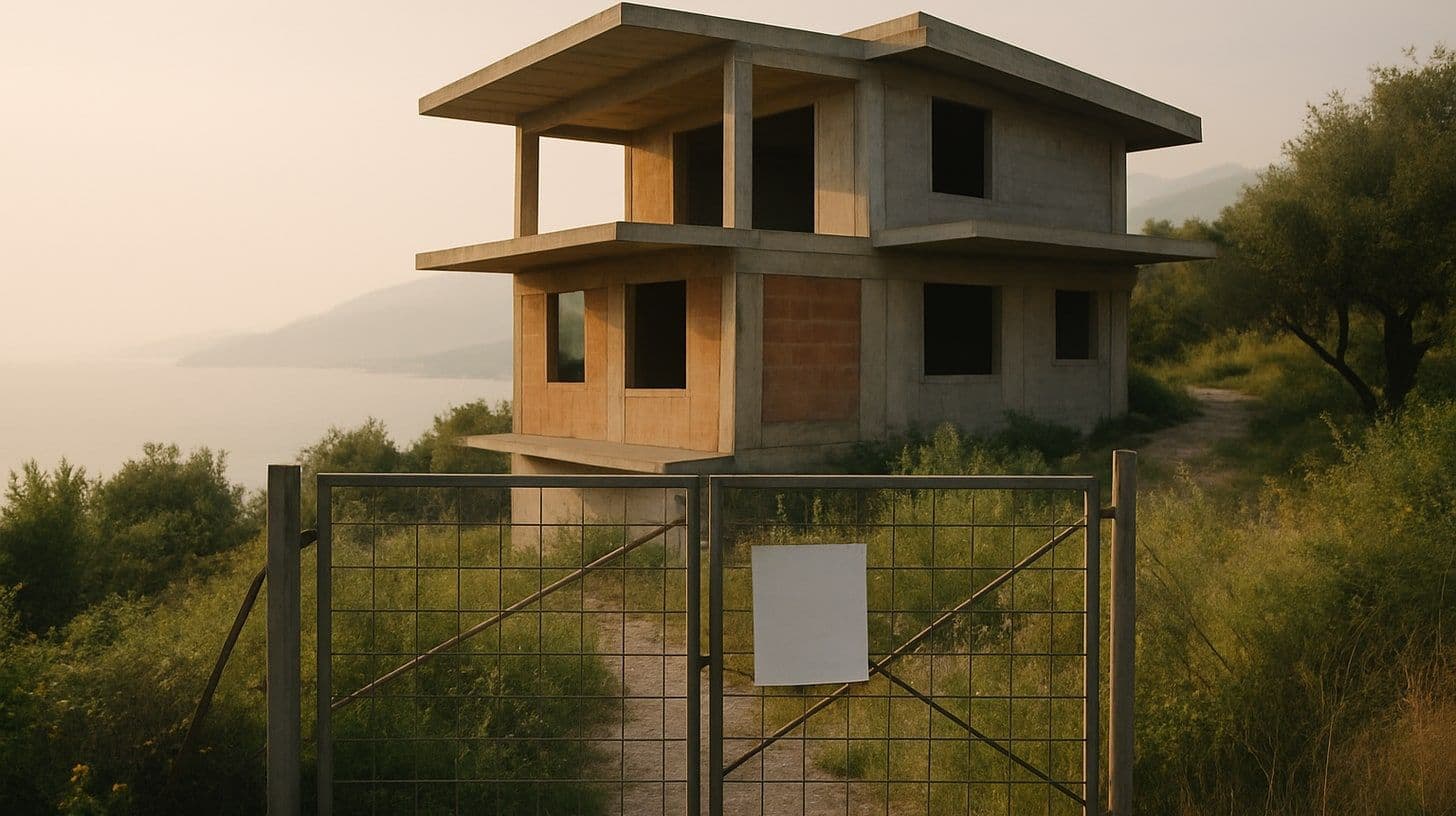
What does "legalizacija u toku" in a listing mean for a buyer? Only that a legalisation application has been filed, not that it has been decided. What matters is whether cadastral registration has been initiated: under Article 48 of the legalisation law owners have until 14 August 2027 to do so, after which the inspector must order demolition. Until then the owner pays an annual use charge based on the average construction price per m²: 0.5–2% per net m² with a survey report, 1–3% per gross m² without one.
Learning to read a Montenegrin listing starts with decoding a handful of short Montenegrin phrases. Some are harmless; some change the whole file. The most expensive is "legalizacija u toku": legalisation in progress. This article takes the listing phrases first, then the statute behind them, and finally what 14 August 2027 means, precisely, for a buyer.
Five phrases in the listing
Papiri uredni / čisti papiri. "Paperwork in order." It has no legal content; nobody moves on without asking for the title extract (list nepokretnosti) and the use permit.
Bez upotrebne dozvole. No use permit. Using a building before its use permit is issued is prohibited (Article 60 of the Construction Act). Since February 2026 the legalisation law draws a line here: a unit whose title carries the note "nema upotrebnu dozvolu" may still be sold if it was built in accordance with its building permit. In a new project that is usually a question of time; in an old building the question is whether what stands matches the permit at all.
U postupku etažiranja. Unit registration in progress. The apartments have not yet been separated into individual title units; you may hold the keys, but in the cadastre there is no apartment in your name.
Nadogradnja / prošireno. Added floor, extended. The part of a permitted building that exceeds the permit; the statute treats only the excess as illegal, but if the flat you are buying is that excess, the distinction does not help you.
Legalizacija u toku. An application has been filed; no decision. Everything below is about this phrase.
The statute: 91/25 and two amendments in 2026
Montenegro's legalisation law (Zakon o legalizaciji bespravnih objekata) was published in 2025 (91/25) and entered into force on 14 August 2025. It was amended twice in 2026: in February (18/2026) and in August (117/2026, published on 7 August and in force from 15 August). The first thing the law asks for is visibility: the structure must appear on the satellite and aerial imagery of July 2025 that the ministry publishes on its Geoportal (Article 7). A structure that cannot be identified on that imagery may not be registered in the cadastre, and an existing registration is annulled (Article 48). The February amendment opened one door: an owner who claims the building stood before July 2025 can prove it with a survey report and a construction expert's finding backed by evidence such as the electricity or water connection, utility bills or a property tax decision. For an extra floor added after July 2025, "legalizacija u toku" is the name of a process that cannot legally exist.
For a structure that passes this test, the second question is degree: is the whole building unpermitted, or is it the part of a permitted building that exceeds the permit (Article 2, paragraph 2)? In the second case only the excess is illegal; the file is smaller, but where the apartment sits is decisive.
14 August 2027 is not an application deadline
Online, this date circulates as "the last day to apply for legalisation". Under the current text of Article 48, 14 August 2027 is the end of the period an owner of an illegal structure has to initiate its registration in the cadastre; the period runs from 14 August 2025 and was set first at six months, then at twelve in February 2026, then at twenty-four in August 2026. For a structure whose registration has not been initiated by then, the spatial protection inspector is obliged to issue a demolition order (Article 48, paragraph 2). The August amendment also put the cost of the commission's on-site inspection onto the owner (Article 14). So in a listing that says "legalizacija u toku", the question is not whether an application has been filed but whether cadastral registration has been initiated and whether the survey report (elaborat) is ready. The old and new wording of Article 48 side by side is in RoNa Legal's note on Legalisation Act 117/2026.
The real cost is not the fine but the title and the annual charge
For an owner who stays outside the process, the most corrosive item is not a fine but an annual use charge (Article 26). It is owed for a structure with no legalisation application, with a refused application, with no cadastral registration initiated, or with a demolition order. With a survey report filed it is 0.5 to 2 percent per net square metre a year; without one, 1 to 3 percent per gross square metre. The base is the average construction price per square metre of new housing in Montenegro that the statistics office publishes for the previous year; the municipality sets the zones and the rate. At the national construction price MONSTAT gave for the last quarter of 2025, 1,724 euros per square metre, that is roughly 9 to 34 euros per net square metre, or 17 to 52 per gross square metre, every year; for a 150 m² house, a four-figure sum. A demolition order does not stop it: property tax and this charge keep running (Article 31, paragraph 5).
For a buyer the real wall is Article 33: an illegal structure cannot be transferred and cannot be used for economic activity, and the prohibition is entered as a note in section G of the title. The February 2026 amendment lists the exceptions: a mortgage and an out-of-court sale, a lease, inheritance, gifts and division among first-order heirs, lifelong maintenance contracts within the family, transfers based on a court decision or an enforcement sale, and economic activity for 36 months from the law's entry into force. An ordinary sale to a stranger is not on the list, apart from the permit-compliant unit described above. The cadastre, meanwhile, has 36 months to enter the note (Article 51); a section G that looks clean today shows not that the building is legal but that the administration has not reached it yet. The imagery check therefore does not replace the title check; it sits beside it.
If it is legalised, what is paid
If the application succeeds, a legalisation fee (naknada za urbanu sanaciju) is paid to the municipality per net square metre; the municipality sets the tariff with government approval. Up to 120 monthly instalments, 360 for a primary residence; 80 percent of the fee goes to the municipality and 20 to the state (all of it local in the northern municipalities). Reductions do not stack: up to 50 percent for a primary residence, up to 90 percent for vulnerable groups, up to 20 percent for payment in one sum. For four- and five-star hotels, tourist settlements and resorts the fee is fixed in the statute at 400 to 800 euros per square metre, in one sum or at most 60 instalments. Coastal municipalities add a separate water-supply charge, in up to 36 instalments (Articles 23 and 25).
Read those figures from the buyer's side: a seller's offer of "legalisation has started, you can take over the instalments" is an empty offer for as long as Article 33 makes transfer impossible. Transfer opens only with the decision; the cadastre then has 40 days to delete the notes from section G (Article 21), and at that moment the whole fee and the remaining instalments are on the table.
The reading order for a listing
| Phrase | Document to ask for | Decision |
| Papiri uredni | List nepokretnosti (A, B, G) + upotrebna dozvola | No progress until the documents arrive |
| Bez upotrebne dozvole | Building permit + proof the unit matches it | Built to permit: a sale is possible; otherwise treat it as illegal |
| U postupku etažiranja | Etažiranje decision and unit registration | No payment before the decision |
| Nadogradnja | Permit + comparison with the July 2025 imagery | If the flat is the excess, withdraw |
| Legalizacija u toku | Elaborat, cadastral application, visibility on the imagery | No transfer until the decision |
A building with a permit that has lapsed or a project left half-built follows a different route, which the fourth gate of our land and villa article describes. The general checklist for a resale purchase is in our title and debt check.
We ask sellers on Fijaka's property listings to state the use permit position; where it is missing, let your first message be not the price but "is there an upotrebna dozvola". For buyers who would rather have the imagery and section G read by a lawyer, RoNa Legal's Budva office does that as a standard part of pre-purchase screening.
Information only; not legal advice. The legalisation law changed twice in 2026; have the text in force on the listing date confirmed by your lawyer.