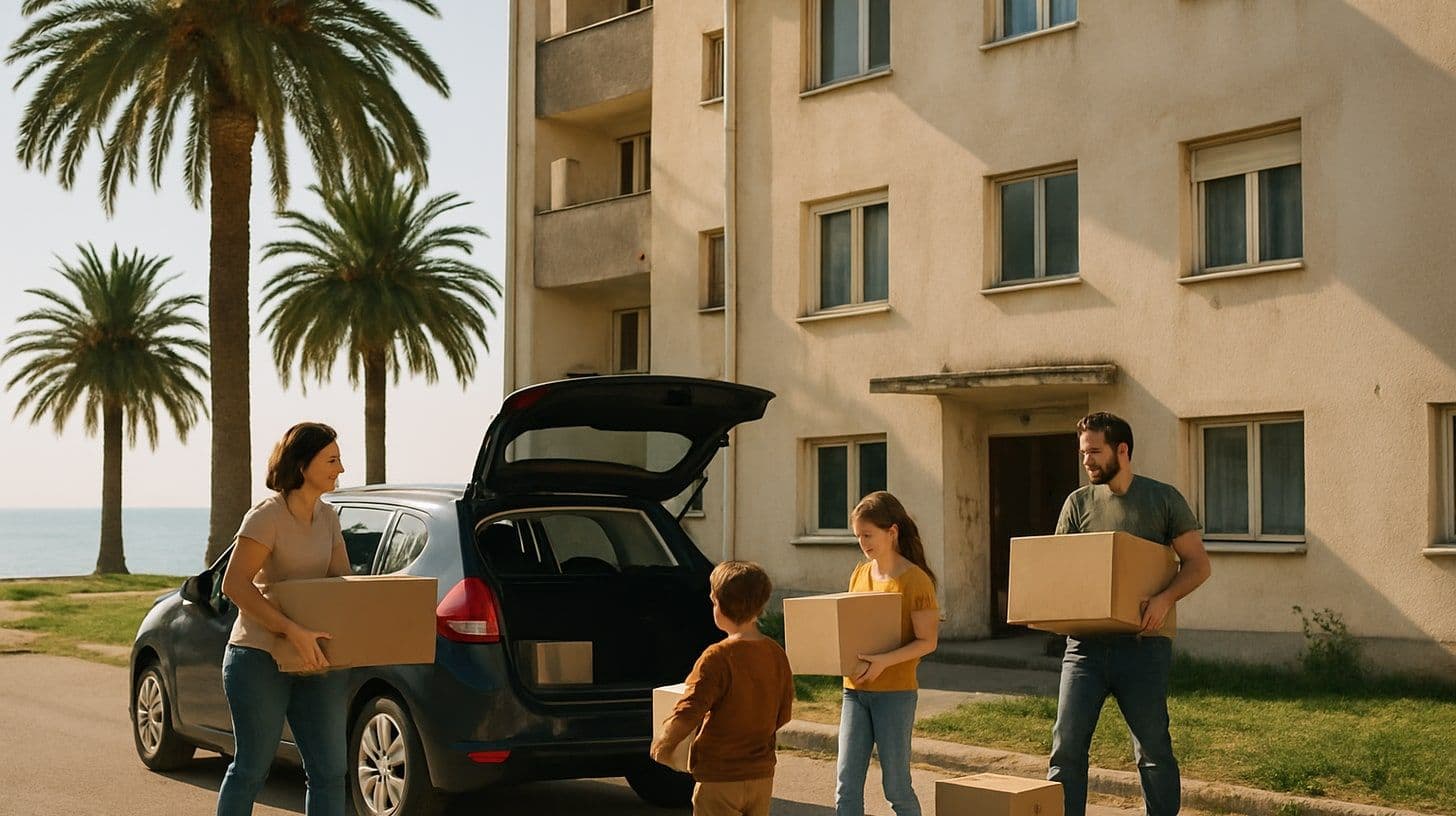
What is the first thing to do after moving to Montenegro? Register your address: within 24 hours yourself if you stay with a friend or in a flat you rent; in a hotel or registered accommodation the business does it within 12 hours. Then sign a written lease, move the address registration (prijava boravišta) to it and file the residence application; the Interior Ministry decides within 40 days of a complete file. Filing a complete application before your visa-free stay runs out lets you remain until the decision.
Relocation articles usually open with a list of what you need. In Montenegro the real issue is not what you need but what comes before what. Without address registration no residence file can be opened; without a permit there is no local status to build on; without health insurance no permit is renewed. A family that mixes up the order collects the same document three times. The calendar below is the first ninety days of a family settling in Bar; for Budva or Podgorica only the queues change, not the dates.
Day 0: arrival and the 24-hour rule
On entering Montenegro a foreigner must have their address registered with the police or the local tourist organisation. If you are staying in a hotel or a registered accommodation business, the business does it and its deadline is 12 hours. If you are staying with a friend, or in a flat you have taken without a lease yet, you register yourself and your deadline is 24 hours. Confusing the two is the most common mistake of the first week; a late registration means every later file asks about the gap between "date of first entry" and "date of first registration".
How long you can stay before any of this becomes urgent depends on your passport. EU, UK and US nationals have 90 days in any 180; several other nationalities, Turkey, Russia, China, Saudi Arabia and Belarus among them, need a visa from 1 November 2026. Who enters visa-free after that date is listed in RoNa Legal's note on visa-free nationalities. Whatever the allowance, it is not enough for everything below; the first entry should be day one of a decided move, not a house-hunting trip. One rule helps: a foreigner who files a complete residence application before their visa-free stay runs out may remain in Montenegro until the decision is final (Article 61 of the Law on Foreigners).
Week one: lease, then address registration, then the file
For the "proof of housing" in a residence file, a title deed, a lease or a written statement from a host carry equal weight. Finding a landlord willing to sign a written lease can be harder than finding the flat; a landlord who does not want to declare rental income blocks your file without meaning to. We compared buying and renting from the file's point of view in an earlier article; the short version is rent in the first year, and decide on buying once you know the country.
Once the lease is signed, the address registration moves to that address (prijava boravišta), and only then can the residence file be opened. Under Article 43 of the Law on Foreigners the file holds a passport valid at least three months beyond the permit, proof of housing, means of subsistence, health insurance, a criminal record certificate from your home country and the documents for the legal basis. Which basis? The usual ones are property, a company, an employment contract, family reunification and the digital nomad permit; only one of them fits your file, and for a remote worker the choice between the last two routes is set out in our comparison of the digital nomad permit and a DOO.
Days 10 to 40: the file is at the ministry
The Interior Ministry decides within 40 days of a complete file (Article 62); the clock only starts once nothing is missing. Two things happen in parallel.
First, the bank account. Banks take personal account files without waiting for the permit, but in our files they look longer at an application without a card. Rent, electricity and school fees will need an account, so apply while the file is at the ministry. Second, health insurance: a private policy is accepted in the file. Someone who takes a permit for employment is registered for compulsory social insurance within 24 hours of the permit; someone on a property-based permit keeps a private policy and renews it every year.
Days 40 to 60: spouse and children
In Montenegro a family is not one file but a chain of files. Your permit comes first; then the family reunification files for the spouse and minor children. Article 44 of the Law on Foreigners lists the close family: spouses, their minor children born in or out of wedlock, the children of one spouse and adopted children under 18, and the parents or adoptive parents of a minor child. Each needs an apostilled marriage or birth certificate, a sworn translation, health insurance and, for anyone over 16, a criminal record certificate. A family member's permit runs at most until yours expires; if yours falls, theirs has nothing left to rest on. The plan "my spouse comes in as a tourist and we sort it out later" hits the visa wall for several nationalities after 1 November.
If a child is starting school in September, open the family files early enough that the child's status is settled by the start of term.
Days 60 to 90: car, furniture and the absence limit
For families arriving with a foreign-plated car, registration in Montenegro is a separate file; ask about the residence, customs and homologation requirements before you start. The road charge paid at registration currently follows a 2005 tariff; a new government decision adopted on 18 June 2026 applies from 1 July 2027 and sets the annual charge for passenger cars by engine size from 5 to 32.50 euros (16 euros for 1,351–1,800 cm³). Under the new decision a new owner pays nothing more until the period already paid runs out.
On furniture, Montenegro's second-hand market is small but real. Fijaka's second-hand category carries furniture and appliance listings from Budva and around; for most families the customs file for a container from home costs more than buying locally. For assembly, transport and plumbing, Glatko connects you with registered tradespeople.
From the moment the card is in your hand another counter starts. Under Article 65 of the Law on Foreigners, more than 30 days abroad ends a temporary residence permit. Since the January 2026 amendment, a family reunification permit survives a longer absence only for a particularly justified humanitarian reason (force majeure, serious illness, permanent disability) proven to the police before departure, and for a permit on property the article no longer provides an exception at all. The older allowance of up to 90 days for a justified reason, notified to the police in advance, now remains only for the single permit for residence and work (Article 83). For families who travel home often, this counter is the rule that sets holiday plans.
1 November 2026: the date outside the calendar
From 1 November 2026, nationals of Turkey, Russia, China, Saudi Arabia and Belarus need a visa to enter Montenegro. Holders of a valid residence card enter on the card; no visa is needed. For those whose card has not yet been issued, every entry after November means a visa file at a Montenegrin consulate. For those nationalities the ninety-day calendar above should have started in August 2026; a file opened in September can be decided by the end of October, and the rest of the family enters in November on visas. For everyone else one more line matters: a Montenegrin residence card gives no rights in the Schengen area, and Montenegro's own 90/180 rule runs separately from Schengen's.
The ninety days in one table
| Day | Task | Who you are waiting on |
| 0 | Address registration (12 or 24 hours) | Police / tourist organisation |
| 1–7 | Lease, prijava, file opened | Landlord, you |
| 10–40 | Ministry decision; bank and insurance in parallel | MUP, bank |
| 40–60 | Family reunification files | MUP |
| 60–90 | Car registration, furniture, school | Registration office, school |
| 1 November | Visa regime | Those without a card |
RoNa Legal's Budva office runs this calendar as one file per family; the work at the first meeting is deciding on which basis, and in which order, the family applies. When choosing a moving date, aim not for November but for forty days before it.
Information only. Timelines vary with ministry and municipal practice; confirm the current rules before opening a file.