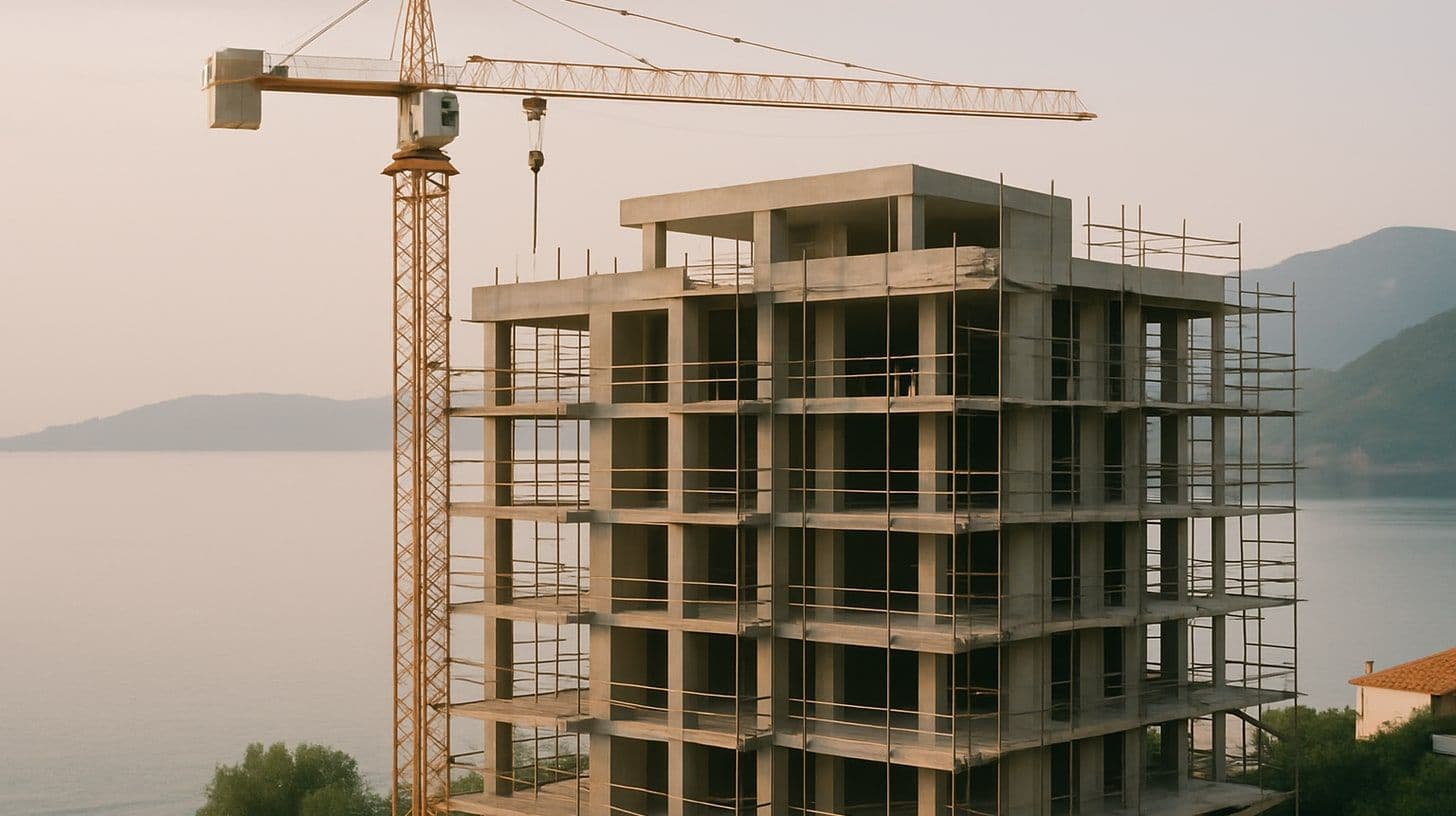
Is it safe to buy a flat off plan? As safe as the permit, the land and the contract. Check the building permit on the authority's website, the charges on the land in the cadastre extract, and sign a contract at a notary with deadlines and penalties.
Buying a flat off plan on the coast or in Podgorica appeals for a simple reason: the price is lower than for a finished flat, and you can choose the layout. But you are paying for something that does not exist yet, and the developer holds both the money and the decision about when the flat will be ready. Local searches reflect this: next to "kupovina stana u izgradnji" (buying a flat under construction), people most often add "iskustva" (experiences), "procedura", "forum" and "na kredit" (with a mortgage), and they search separately for "kupovina stana od investitora" (buying from the developer).
This article goes in the order in which you should check things: the permit, the land, the contract, the tax and, finally, the use permit and registration. The rules come from the 2025 Law on Construction, the Law on Notaries and the Law on Obligations.
The building permit first, the payment second
Without a building permit there is no legal construction, and a building going up without one may not even be connected to the utility networks. The permit is issued by the municipality, and by the Ministry for buildings of 3,000 m² gross floor area or more and for four- and five-star hotels.
The good news is that this is easy to check. The law requires the authority to publish the permit application on its website within three days and the issued permit within seven days. If the developer cannot show you the permit and you cannot find it on the municipality's or the Ministry's website, that is the first and most serious reason to walk away.
The law and the permit also set deadlines that matter to you:
| Deadline in the law | What it means for the buyer |
| Construction must start within two years of the permit | If it does not, the developer loses the right to build |
| Construction must be finished within five years | If it runs late, the developer pays an annual charge for each year of overrun that has begun |
| A change of developer must be filed within 30 days | If the developer changes, check who now owes you the flat |
The annual charge penalises the developer, but it does not give you your money back or speed up the work. The completion date and the consequences of delay therefore have to be in your own contract.
The land and its encumbrances
The cadastre extract for the plot shows who owns the land and whether a mortgage is registered on it. When a developer finances construction with a bank loan, a mortgage on the land or the building is the usual security. It is not in itself a reason to walk away, but before your first payment you need to know how your flat will be released from the charge. A notarial deed on the basis of which a mortgage was registered can be directly enforceable, so in case of default the bank can go straight to the property. What else to check in the cadastre extract is covered in our article on checks before buying.
The contract: at a notary, with deadlines and consequences
A contract transferring ownership of real estate must be made as a notarial deed; a legal transaction not made in that form has no legal effect. The same applies to the preliminary contract: under the Law on Obligations, the form rules for the main contract also apply to the preliminary contract where the form is a condition of validity. A preliminary contract signed "in the developer's office" therefore protects you poorly.
A preliminary contract is binding if it contains the essential elements of the main contract, and if the developer refuses to conclude the main contract, a court can order it to do so. The conclusion can be demanded within six months of the date set for the main contract. Put at least the following in the contract:
- The exact unit: floor, flat number, net area and a floor plan.
- The price and what it includes: VAT, parking, storage.
- A payment schedule tied to construction stages, not to calendar dates.
- The completion date and a contractual penalty for delay.
- A deadline for the use permit and cadastre registration, as the developer's obligation.
- What happens if the project or the permit is changed, and the buyer's right to terminate in that case.
- Refund of payments if the flat is not completed.
VAT instead of transfer tax
On the first sale of a new flat by the developer, no real estate transfer tax is paid; the price includes 21% VAT. Transfer tax is paid only on a resale, so it is worth having the contract state that the price includes VAT. We explain the difference between the two regimes in our article on real estate transfer tax.
The annual property tax does not burden you during construction: since the October 2025 amendments, buildings under construction are not subject to it. The liability arises once you are the registered owner, and how it is then calculated is described in our article on property tax.
The use permit and registration: when the flat becomes yours
A building may not be used before the use permit is issued. The developer applies after the professional supervision is complete, a technical inspection is carried out, and the permit is issued by decision and published on the authority's website within three days. The developer must apply for the building to be entered in the cadastre within seven days of receiving the use permit.
Only then can your flat be registered in your name, and you acquire ownership through registration, not through the signature or the keys. If the developer offers to let you move in before the use permit, that is not a favour but a risk: the flat may not be used, and registration is delayed.
If a note appears in the cadastre extract that the building has no use permit, that does not automatically mean it cannot be sold. What exactly it means and when the flat can still be sold is explained in our article on legalisation and the August 2027 deadline.
Checks before the first payment
| What you check | Where |
| Building permit and developer | Website of the municipality or the Ministry |
| Landowner and mortgages | Cadastre extract for the plot |
| Completion date and penalty | Contract at the notary |
| Payment schedule by stage | Contract at the notary |
| VAT included in the price | Contract and invoice |
| Use permit | Website of the authority that issued the building permit |
If you would rather buy a finished flat than one off plan, current supply is in the Montenegro real estate listings.
Frequently asked questions
Does the preliminary contract have to be made at a notary? For real estate the main contract is a notarial deed, and the form rules for the main contract also apply to the preliminary contract where form is a condition of validity. So conclude it at a notary.
Is transfer tax paid on a flat bought from the developer? Not on the first sale. The price includes 21% VAT; transfer tax is paid on a later resale.
What if the developer runs late? The law requires the developer to finish within five years or pay an annual charge, but that does not compensate you. The deadline and the contractual penalty must be in your contract.
Can I move in before the use permit? No. A building may not be used before the use permit, except for trial operation of equipment.
When do I become the owner? On registration in the cadastre, which is possible only once the developer has the use permit and has registered the building.
Sources
The rules on permits, deadlines and use come from the Law on Construction (Official Gazette of Montenegro 19/2025). The notarial deed requirement is set by the Law on Notaries (Article 52), and the rules on preliminary contracts and on the form of contracts transferring real estate by the Law on Obligations (Articles 40, 61 and 64). Fijaka is a classifieds platform and does not give legal advice; for a specific contract, consult a notary or a lawyer.