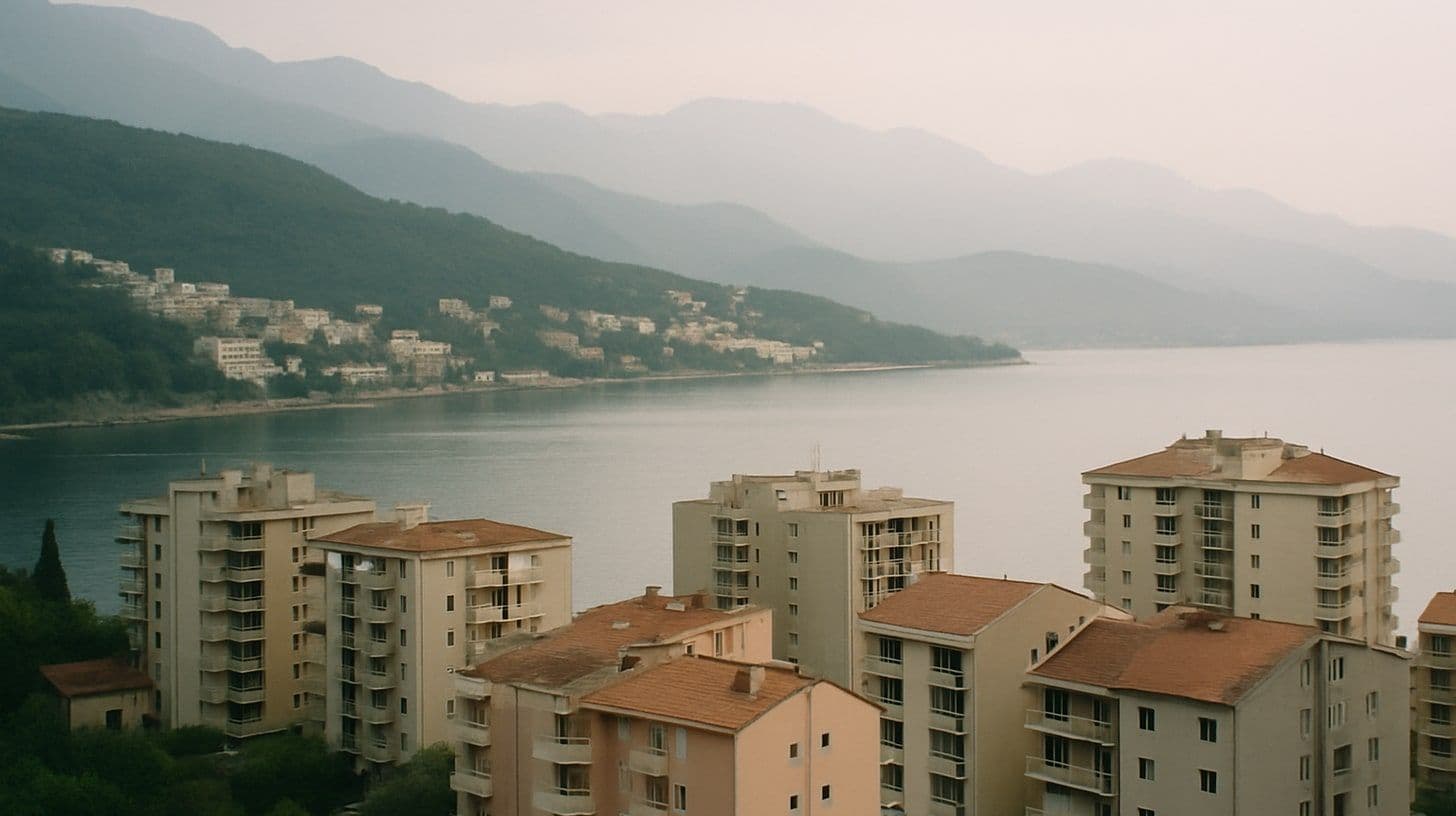
Where is the best place to buy property in Montenegro? It depends on whether you need year-round income. Podgorica has steady demand tied to employment; the coast has higher seasonal rates and quiet winters.
Most "best places to buy in Montenegro" articles are ranked lists with no numbers in them. This one starts from the official price series and then explains the trade-off that actually decides the answer, which is not scenery but whether demand exists in February.
Before the locations, one thing worth clearing up, because the questions people search alongside this one are overwhelmingly about permission rather than preference: can foreigners buy, can US citizens buy, is it safe.
Who is allowed to buy
A foreign individual can own an apartment or a house in Montenegro on the same terms as a citizen. Nationality is not the gate, and there is no reciprocity test to pass. The restrictions attach to land, not to passports: agricultural land, forest and forest land can be acquired by a foreign individual only up to 5,000 m² and only where a dwelling on that land is the subject of the contract, and property in zones closed for security reasons cannot be acquired at all.
The usual workaround for a larger or bare plot is to buy through a Montenegrin company, which counts as a domestic legal person even when wholly foreign owned. That is a question of capacity to own rather than a tax structure.
"Is it safe" is a different question, and the honest answer is that the risk in Montenegro is rarely the location and almost always the legal status of the specific building: whether it is registered in the cadastre and whether it was built with a permit. That risk exists in Budva and in Podgorica equally, and it is checked the same way in both.
What the official numbers say
MONSTAT publishes average prices per square metre for newly built dwellings for the whole country, for Podgorica, and for three regions. Euros per m²:
| Period | Montenegro | Podgorica | Coastal region | Central region | Northern region |
| 2024 | 1,844 | 1,810 | 2,028 | 945 | 1,306 |
| 2025 | 2,200 | 2,127 | 2,412 | 1,202 | 1,533 |
| Q1 2026 | 2,445 | 2,395 | 2,575 | none reported | 1,708 |
| Q2 2026 (preliminary) | 2,557 | 2,510 | 2,838 | 2,131 | 2,145 |
Two warnings before anyone ranks locations on this.
The series measures the sale price of new-build units sold in that quarter, as reported by the developers selling them. It is not a resale index and not an appraisal. And apart from Podgorica there are no city figures: the coastal column averages Bar, Budva, Herceg Novi, Kotor, Tivat and Ulcinj together, the central column covers Cetinje, Danilovgrad, Nikšić, Tuzi and Zeta, and the northern column the rest. There is no official new-build figure for Budva on its own. Treat the national and Podgorica columns as meaningful, read the coastal column as a regional average, and verify any specific town against current listings before you price anything on it. Source: MONSTAT's new-build price database.
What does survive the caveats: the coastal region has been the most expensive column in every quarter since the start of 2024, above both the national average and Podgorica. In 2022 and 2023 Podgorica was slightly higher.
The trade-off that actually decides it
Strip away the scenery and the choice is between two different demand patterns.
| Coast (Budva, Bar, Tivat, Kotor) | Capital (Podgorica) | |
| Demand driver | Tourism and foreign buyers | Employment, students, administration |
| Peak season | July and August | None; steady |
| Winter | Quiet, some districts largely empty | Unchanged |
| Letting model | Seasonal, high rate, empty months | Year-round, lower rate, fewer gaps |
| Buyer pool on exit | Largely foreign | Largely domestic |
| Main risk | Season-dependent, sentiment-sensitive | Tied to local incomes |
The coast offers the higher headline rate and the scenery that drives resale demand, and it comes with empty months, higher maintenance from salt and damp, and a buyer pool that thins when foreign sentiment turns.
Podgorica offers year-round demand and a domestic buyer pool, and it is capped by local incomes: the average net wage was 1,036 euros in June 2026, which is the ceiling long-term rents ultimately clear against.
There is no universally correct answer, but there is a correct question: do you need this property to produce income in February? If yes, the capital and the year-round coastal neighbourhoods are the honest options. If no, and you are buying somewhere you will use and eventually sell, the coast is what you are actually buying.
Choosing within the coast
Not all coastal addresses behave alike, and the distinction matters more than the town name. Districts with a resident population keep shops, schools and transport running through winter; purely seasonal developments empty out after October. A flat in a year-round neighbourhood is easier to let long term, easier to live in, and easier to sell to a buyer who intends to live there.
Our own supply is concentrated in Budva, where the current listings sit across Bečići, the centre, Podkošljun and Pržno; you can see what is live on the Budva page, and the wider market on the Montenegro real estate listings.
Before you commit anywhere
- Check the cadastre record for ownership, mortgages and whether the building is registered.
- Ask whether it is the first transfer. New build from a developer carries 21% VAT in the price; resale carries the progressive transfer tax instead (3% to a 150,000 euro base, then 5%, then 6% above 500,000).
- Budget the running costs. Annual property tax is 0.25 to 1.00 percent of market value, set municipally.
- Plan the exit. Capital gains are taxed at 15 percent on the difference between sale and purchase price, with an exemption where the property was your sole and main residence; the rules on capital gains and dividend tax set out how residents are treated. Fijaka is a marketplace and does not give legal advice.
- Keep the purchase contract. It sets your acquisition cost and therefore your future tax base.
If you are selling rather than buying, listing is free.
Frequently asked questions
Can foreigners buy property in Montenegro? Yes, apartments and houses on the same terms as citizens. Restrictions apply to agricultural land, forest and security zones, and to plots above 5,000 m² without a dwelling.
Can US citizens buy property in Montenegro? Yes. There is no nationality restriction on built property and no reciprocity requirement.
Which area is most expensive? In the official new-build series the coastal region (Bar, Budva, Herceg Novi, Kotor, Tivat and Ulcinj together) has had the highest figure in every quarter since the start of 2024, at 2,838 euros per m² in the second quarter of 2026 on preliminary data. There is no separate figure for a single coastal town.
Is there an official price per square metre for Budva? No. Apart from Podgorica, MONSTAT publishes regions, not towns; Budva is part of the coastal region average.
Is it safe to buy? The location is rarely the risk. Verify the cadastre record and whether the building was legally built; that is where problems appear.