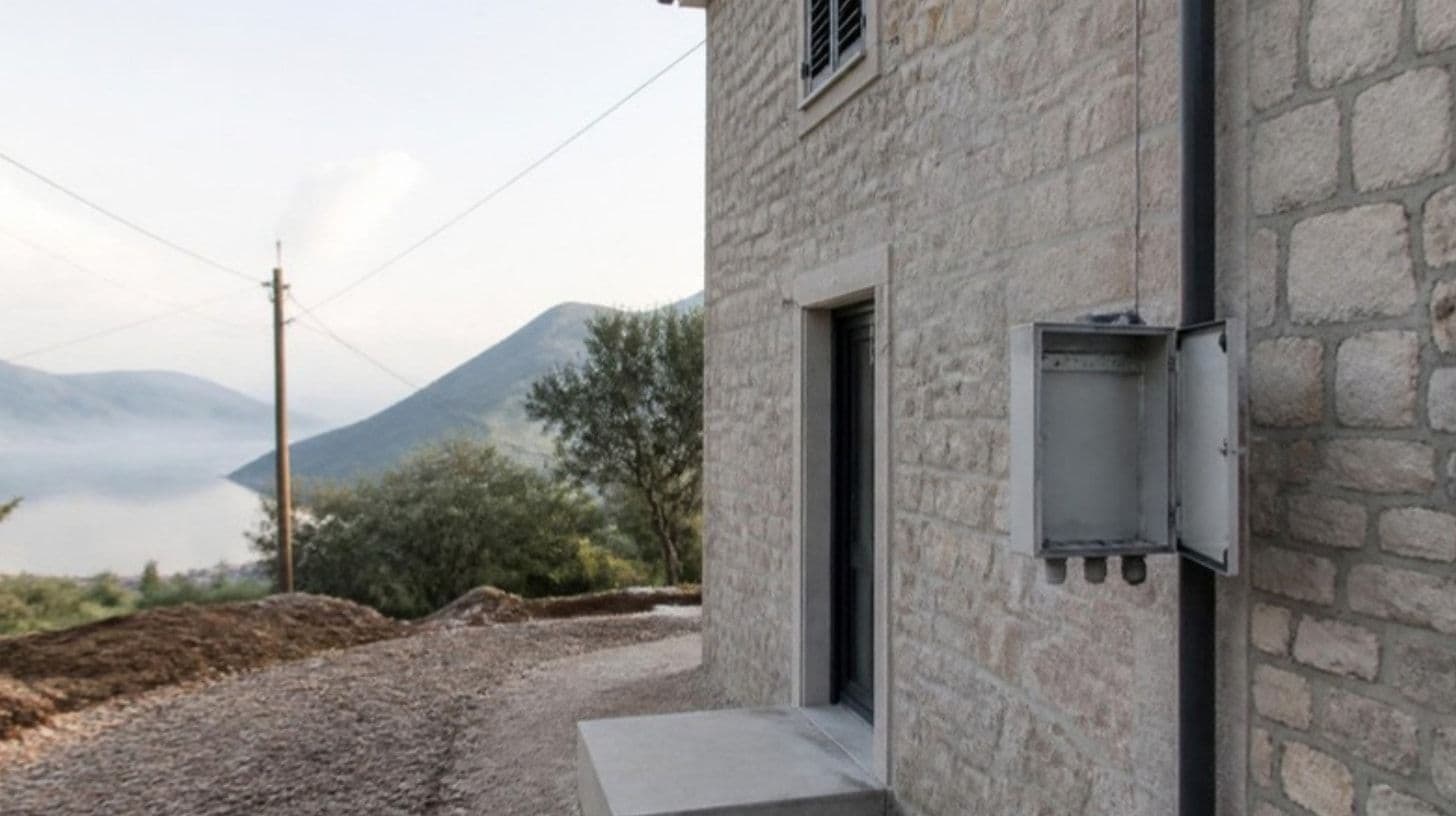
A new house or building in Montenegro is connected to the distribution grid by CEDIS, under a contract for building the connection infrastructure and connection. CEDIS must send the draft contract within 15 days of a complete request, you pay the connection power fee within 15 days of signing the contract, and once the supplier registers the supply contract, CEDIS connects the building within 7 days at most. Under the latest published CEDIS decision, the fee for a low-voltage connection is 25.36 euros per kVA excluding VAT.
The rules come from the 2025 Energy Law and the CEDIS procedure. This guide explains the order of the connection steps, what it costs, who builds the line to the building, what applies to a building site and a plot, and what you must do after connection.
When does the connection process start?
It starts before the house is finished. At the request of the competent authority, CEDIS issues technical conditions for connection, which become part of the urban planning and technical conditions for the build. They require data on the building, the power needed, the number of metering points and the location. The technical conditions set, among other things, the connection point and the metering point.
Once the main design is ready, CEDIS gives an opinion on the main design at the request of the design reviewer. If the design does not follow the technical conditions, the opinion is negative and lists the defects to fix. All the steps from buying a plot to building are covered in our article on buying land to build a villa.
How does the connection work, step by step?
| Step | Who and what | Deadline |
| Request to conclude the contract | The building owner or investor files a request on the CEDIS form | When you have the required documents |
| Draft contract | CEDIS sends the draft contract | 15 days from a complete request |
| Exception for larger facilities | Generating facilities over 50 kW and customer facilities over 150 kW | Up to 90 days |
| Paying the fee | You pay the connection power fee | 15 days from signing the contract |
| Notice of fulfilled obligations | You notify CEDIS on its form | When the line, installations and measurements are done |
| Supply contract | You sign it with your chosen supplier, who registers it with CEDIS | After the CEDIS notice |
| Connection | CEDIS connects the building, installs and seals the meter | No more than 7 days from registration of the contract |
| Expert report | You submit a report by an authorised organisation on the installations | 7 days from connection |
The contract sets the connection conditions and point, the connection power fee, the connection method, the technical conditions and connection deadline, and the metering point and method. CEDIS decides the connection point, and it installs the meter as its own asset and maintains it. If you disagree that the draft contract follows the rules, you can refer the dispute to the energy regulator (REGAGEN).
How much does an electricity connection cost?
The fee is paid per metering point and equals the approved connection power in kVA multiplied by the unit fee. Connections of the same power at the same voltage level must pay the same fee. Under the 2022 CEDIS decision, the unit fees excluding VAT are:
| Voltage level | Fee |
| 0.4 kV (low voltage, houses and flats) | 25.36 euros per kVA |
| 10 kV | 20.76 euros per kVA |
| 35 kV | 8.65 euros per kVA |
Examples under that decision:
- a house with an approved power of 10 kVA at low voltage pays 253.60 euros excluding VAT;
- an existing user raising the power from 10 to 15 kVA pays only for the difference of 5 kVA, that is 126.80 euros excluding VAT.
In July 2026 CEDIS published a new methodology for the fee and committed in it to adopt a new decision on the amount within 30 days. Before signing the contract, check the amount valid on the day; in any case it is written into the contract itself.
Who builds the line to the building and who pays for it?
When CEDIS sends the draft contract, you can choose whether CEDIS builds the connection infrastructure or you build it yourself. If you build it at your own cost:
- the contract sets the construction deadline, CEDIS's role in monitoring the works and CEDIS's obligation to buy the infrastructure from you;
- CEDIS values low-voltage infrastructure using its buy-back price list, and for other levels it hires an independent valuer;
- the buy-back contract is signed no later than 6 months after the occupancy permit is issued, and CEDIS must offer to pay the amount with interest in no more than 20 equal annual instalments.
If CEDIS finds technical constraints in the grid, for example missing spatial planning prerequisites, it will notify you that the request is rejected.
What applies to a building site, a temporary structure and a plot without a house?
The law governs the connection of a building. Building sites and temporary structures built in line with the construction law can be connected temporarily, as can buildings approved for trial operation. For a plot where you are just building a house, you therefore get power as a building site connection, not as a connection of the plot itself.
Under the 2026 methodology:
- a building site is charged only for power above that of the building it serves, and if the building's approved power is higher, the site pays no fee;
- a temporary structure pays no fee if the connection lasts less than 90 days;
- anyone who demolishes a connected building and builds a new one in its place pays only for the approved increase in power.
What must you do after connection?
Within 7 days of connection you submit to CEDIS an expert report by an authorised organisation confirming that the installations meet the technical conditions for the safety of people and property. If you do not submit it on time, CEDIS suspends the power supply. Electricians and contractors for internal installations can also be found through the Glatko platform.
If you buy a house or flat that is already connected, you do not need a new connection but a change of user on the existing meter, described in our article on transferring electricity and water to a new owner. If you plan solar panels on the roof, the rules for prosumers are explained in our guide to solar panels on a house.
Checklist
| Check | Why |
| CEDIS technical conditions in the urban planning conditions | They set the connection and metering points |
| Power needed and number of metering points | The fee depends on them |
| Who builds the line to the building | It changes costs and the buy-back contract |
| The fee on the day of the contract | The 2026 methodology requires a new decision on the amount |
| Expert report on the installations | Without it CEDIS suspends supply |
Frequently asked questions
How much does an electricity connection for a house cost? The fee equals the approved power in kVA multiplied by the unit fee. Under the 2022 CEDIS decision, low voltage costs 25.36 euros per kVA excluding VAT, for example 253.60 euros for 10 kVA; check whether a new decision has been adopted since.
How long does the connection take? CEDIS sends the draft contract within 15 days of a complete request, and connects the building within 7 days at most of the supply contract being registered. The total time also depends on building the line and the installations.
Can a plot without a house be connected? The law governs the connection of a building. For a plot where you are building, you get power as a building site connection, and temporary structures built in line with the law can also be connected temporarily.
Who builds the line from the grid to the house? The applicant chooses: CEDIS builds it or you do. If you build it yourself, CEDIS buys it back and pays in no more than 20 equal annual instalments.
What if I increase the power of an existing connection? A new contract is signed, and you pay only the difference between the requested and the previously approved power.
What happens if I do not submit the expert report? If you do not submit the authorised organisation's report on the installations within 7 days of connection, CEDIS suspends the power supply.
Sources
Connection is governed by the Energy Law (Official Gazette of Montenegro 28/2025 and 3/2026, articles 164 to 173; the 2026 amendment changes only article 171 on temporary connection), the fee by the Methodology for determining the fee for connection to the distribution system (Official Gazette of Montenegro 99/2026, articles 3, 9 and 10) and the Decision on the connection fee (Official Gazette of Montenegro 130/2022), and the steps of the procedure are published by CEDIS. The rules were checked on 24 September 2026. Fijaka is a classifieds platform and does not provide legal or technical advice; for a specific connection, contact CEDIS or a licensed designer.