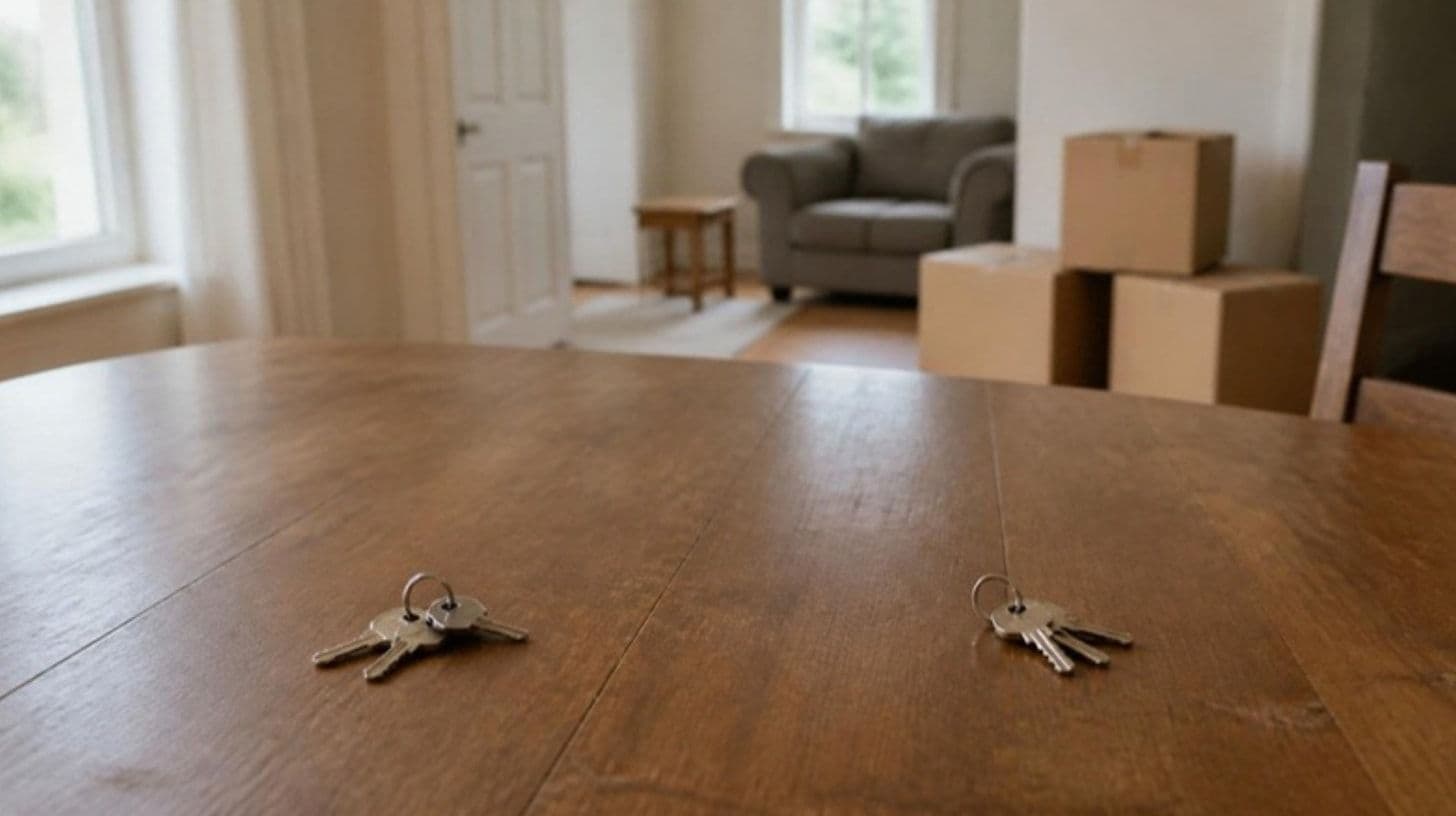
In Montenegro property that spouses acquire through work during the marriage is their joint property (marital assets) and, unless they agree otherwise, it is divided in equal shares. What each of you owned before the marriage and received during it by inheritance or gift remains separate property. A flat bought during the marriage counts as joint even when the cadastre lists only one spouse, and former spouses dividing joint property on divorce pay no property transfer tax.
The rules come from the Family Law, and the tax rules from the laws on property transfer tax and personal income tax. This guide explains what belongs to joint property, how it is divided, what happens to the loan, what a marriage contract changes and what applies when the spouses are foreigners.
What is joint and what is separate property?
| Property | Type |
| A flat, car or savings acquired through work during the marriage | Joint |
| Income from joint property, for example rent | Joint |
| Income from separate property earned through the spouses' work | Joint |
| Property acquired through insurance, gambling or intellectual property rights during the marriage | Joint |
| Property a spouse owned before the marriage | Separate |
| Inheritance and gifts received during the marriage | Separate |
Each spouse manages and disposes of their separate property alone. If during the marriage the value of one spouse's separate property rose slightly, the other has a money claim in proportion to their contribution, and if it rose significantly, a share in that property in proportion to their contribution. This is a common situation with an inherited house that you renovated together.
The same rules apply to an unmarried couple living together: property acquired through the work of unmarried partners is their joint property.
What if the flat is registered to only one spouse?
Joint property is entered in the cadastre in the names of both spouses, without defined shares. If only one spouse is registered as owner, the registration is treated as made in the names of both, unless it was made on the basis of a written contract between the spouses. If you are registered as co-owners with defined shares, for example one half each, you are treated as having already divided the joint property.
Until the property is divided, neither spouse can dispose of or encumber their share by a legal transaction, and the spouses manage and dispose of joint property together and by agreement. Check how the flat is registered in the cadastre extract.
How is property divided: by agreement or in court?
- Agreement. Spouses can divide property by defining shares in all of it or in a single item, by giving each of them particular items, or by one paying the other the value of their share. The agreement must be in writing.
- Court. Without an agreement the property is divided in equal shares. A spouse who proves that their contribution was obviously and significantly greater can ask for division according to contribution. The court then weighs not only income but also help to the other spouse, work in the household, care for the children and any other work in maintaining and increasing the property.
You can ask for division both during the marriage and after the divorce. The heirs of a deceased spouse can also ask for it, as can a creditor of one spouse who cannot collect the claim from that spouse's separate property. At a spouse's request, items used for their profession go into their share first, items purely for personal use are given in addition to their share, and the parent who has custody of the children also receives the items intended for the children.
How does the divorce proceed and where is property settled?
- Petition. A divorce is sought by a lawsuit or by a joint petition for divorce by agreement. A joint petition must be accompanied by a written agreement on parental responsibility and on the division of joint property.
- Mediation. The court refers the parties to a first meeting with a mediator for reconciliation or for an agreement on the children and the property, except where mediation would not be appropriate because of suspected domestic violence. Reconciliation ends within one month, and the procedure for agreeing the consequences of the divorce within 60 days.
- Judgment. A settlement on dividing property reached in mediation is entered in the divorce judgment. In a divorce by agreement the court does not examine the reasons, and the petition can be withdrawn until the judgment becomes final.
- End of the marriage. The marriage ends when the divorce judgment becomes final.
If one spouse files a lawsuit and the other expressly declares, by the close of the main hearing, that they do not contest it, the spouses are treated as having filed a joint petition for divorce by agreement. A divorce cannot be sought during the wife's pregnancy or until the child turns one year old, unless the wife agrees.
Example: a flat worth 160,000 euros
| Situation | Result |
| Flat bought during the marriage from both spouses' salaries for 160,000 euros, registered only to the husband | It is treated as registered to both spouses |
| No agreement, similar contributions | Each is entitled to half, worth 80,000 euros |
| One spouse keeps the flat and pays the other out | A payment of 80,000 euros, with no transfer tax |
| The wife proves an obviously and significantly greater contribution | The court divides by contribution, not in halves |
| A house the wife inherited, renovated during the marriage | The house stays hers; the husband can claim money or a share in proportion to his contribution |
What happens to debts and the loan?
For a debt a spouse took on alone, that spouse is liable with their separate property and their share of the joint property. For obligations taken on for the current needs of the marriage, and for obligations that under general rules burden both spouses, the spouses are jointly and severally liable, with both joint and separate property.
If you both signed the loan, you both remain debtors of the bank after the divorce. An agreement that one of you takes over the whole debt binds the bank only once the bank consents. A mortgaged flat can be sold or transferred, and how the mortgage is discharged is explained in our article on selling mortgaged property.
What does a marriage contract change?
With a marriage contract, spouses arrange their property relations on existing and future property, before or during the marriage, differently from the statutory regime. The contract is made in writing and certified by a notary, who reads it to the parties and warns them that it excludes the statutory regime of joint property. A marriage contract that concerns real estate is entered in the cadastre.
Is tax due and how is the new division registered?
- Property transfer tax is not paid by former spouses when dividing joint property because of divorce. How this tax is otherwise calculated is explained in our article on property transfer tax.
- Capital gains tax is not paid on a transfer between spouses directly connected with divorce. If you later sell the flat, the rules for the sale are described in our article on capital gains tax.
- Cadastre. The new division is entered in the cadastre on the basis of the division agreement or a final judgment. If you become co-owners with defined shares, selling a share is governed by the co-ownership rules described in our article on co-ownership and the right of first refusal.
What else should you know?
- Gifts. Gifts you gave each other before or during the marriage are not returned. Only gifts from separate property that are disproportionately large compared with the donor's whole property are returned, unless that would be manifestly unjust.
- Living with the child. The child and the parent with custody have a right to live in a flat owned by the other parent if they do not own a habitable flat, at most until the child comes of age.
- Foreign spouses. A court in Montenegro has jurisdiction over the divorce and property relations if one spouse is a Montenegrin citizen, if both have their habitual residence in Montenegro, or if one of them does, unless it is obvious that the decision would not be recognised in a state of which one of them is a citizen. The divorce is governed by the law of the spouses' common citizenship and, if they have none, by the law of their common habitual residence. The law firm RoNa Legal analyses divorce and property division for foreigners, and how documents are prepared for a marriage with a foreigner is covered in our guide to getting married in Montenegro.
Checklist
| Check | Why |
| Cadastre extract for every flat and plot | It shows who is registered and how |
| Evidence of where the money came from | It separates separate property from joint property |
| Loan agreements and mortgages | They show who owes the bank |
| Whether there is a marriage contract | It can exclude the statutory regime |
| Written division agreement | A condition for divorce by agreement |
Frequently asked questions
Is property always split in half after a divorce? Not always. Without an agreement it is divided in equal shares, but a spouse who proves an obviously and significantly greater contribution can receive a larger share.
Is a flat bought during the marriage joint even if it is registered to one spouse? Yes, the registration is treated as made in the names of both spouses, unless it was made on the basis of a written contract between them.
Does an inheritance count in the division of property? No. An inheritance or gift received during the marriage is separate property, but the other spouse can claim money or a share if they contributed to increasing its value.
Is tax due when one spouse takes over the flat? Former spouses dividing joint property because of divorce do not pay property transfer tax, and capital gains tax is not paid on a transfer directly connected with divorce.
Who repays the loan after the divorce? If you both signed it, you both remain debtors of the bank. An agreement that one of you takes over the debt binds the bank only once it consents.
Can property be divided without a divorce? Yes. You can ask for division of joint property during the marriage too, and a division agreement must be in writing.
Sources
Spouses' property relations and divorce are governed by the Family Law (Official Gazette of the Republic of Montenegro 1/2007 and Official Gazette of Montenegro 53/2016 and 76/2020, articles 45, 56 to 58, 285 to 306, 309 and 322 to 343), the tax exemption by the Law on Property Transfer Tax (Official Gazette of Montenegro 36/2013, 3/2023, 28/2023, 33/2026 and 132/2026, article 14) and the Law on Personal Income Tax (article 37g), the assumption of debt by the Law on Obligations (Official Gazette of Montenegro 47/2008, 22/2017, 123/2024, 94/2026 and 117/2026, article 455), and jurisdiction and applicable law for foreign spouses by the Law on Private International Law (Official Gazette of Montenegro 1/2014, articles 80, 81, 85 and 130). The rules were checked on 24 September 2026. Fijaka is a classifieds platform and does not provide legal advice; for a specific divorce, contact a lawyer.