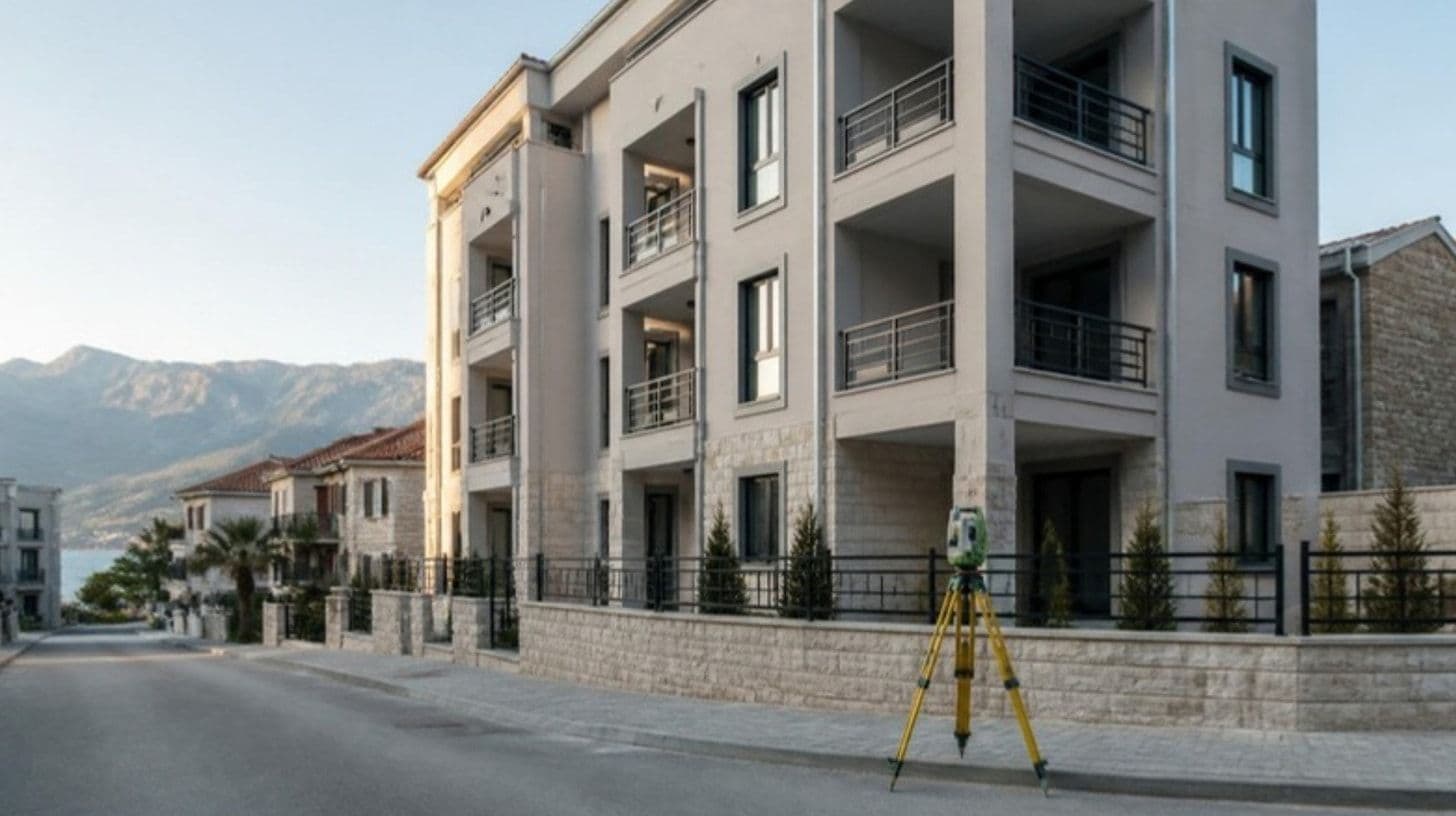
Etažiranje is the registration of a building and its separate units (flats, commercial premises, garages, parking spaces and basements) in the cadastre, so that each separate unit gets its own owner in the cadastre extract, together with joint ownership of the building's common parts and of the land. The investor or right holder reports a change caused by construction to the cadastre within 30 days, the field work is done by a licensed geodetic firm, the cadastre returns the certified survey within 30 days of receiving it, and the right holder bears the costs.
The rules come from the Law on State Survey and Real Estate Cadastre and the Rulebook on creating and maintaining the real estate cadastre. This guide explains what is registered, who is registered as owner, how the procedure works and what a flat buyer should check.
What does etažiranje register?
Condominium ownership (etažna svojina) is registered in the names of the owners of the building's separate units, together with their joint ownership of the building's common parts and of the land on which the building stands. For each separate unit the cadastre records:
| Data | Example |
| Position and shape | Floor and layout in the building |
| Net floor area | Calculated according to a standard |
| Use | Flat, commercial premises, garage |
| Name, address and floor | Entrance and floor |
| Number of rooms | Rooms |
| Year of construction and legal status | For example whether there is an occupancy permit |
Buildings and separate units with their right holders are entered in sheet V of the cadastre extract. A difference in the area of a separate unit that arises only from using a different standard for calculating areas is not considered a change. How to read the extract is explained in our article on the cadastre extract.
Who is registered as owner of a flat in a new building?
- Building. The builder who built the building lawfully, or the builder who was issued a building or occupancy permit, is registered as right holder. The builder of a building not built lawfully is registered with a note of encumbrance in sheet G.
- Separate unit. The investor is registered as right holder of a separate unit, or the person who submits a document proving ownership or legal continuity from the investor, for example a contract for buying the flat from the investor.
- Legalisation. For a building built without a permit, for legalisation, registration is made on the basis of a notarial document drawn up from a statement and a geodetic survey of the as-built state. Since the amendments of December 2025, the building must also be visible on the satellite and aerial image from July 2025.
The joint ownership of the unit owners is registered on the part of the urban plot that belonged to the investor, and the investor files the planning documentation with the boundaries of the urban plot together with the request to register the building.
How does the procedure work, step by step?
| Step | Who | Deadline |
| Reporting the change to the cadastre, with documents | The investor or right holder | 30 days from the change |
| Field work and geodetic survey | A licensed geodetic firm | 30 days from the report; the deadline does not apply when the work is done under a contract |
| Checking, reviewing and certifying the survey | The cadastre | Returns the survey within 30 days of receipt |
| Establishing rights and the registration decision | The cadastre | When the procedure is completed |
Work caused by construction, reconstruction or demolition of buildings may only be done by a geodetic firm that employs at least one geodetic professional authorised for that work. The right holder bears the costs of establishing and implementing the changes. Since the 2025 and 2026 amendments, geodetic firms can submit surveys, and notaries and public bodies can submit registration requests, electronically through the cadastre's e-counter. The law firm RoNa Legal analyses separate unit registration in more detail.
What does the geodetic survey contain?
With the survey the geodetic firm files, among other things:
- its licence for geodetic work and the authorisation of the surveyor who did the measuring;
- the calibration certificate of the instrument used;
- proof of a MontePOS account, if the measuring used satellite positioning;
- in legalisation, an extract from the July 2025 satellite image on whether the building is visible.
A survey submitted through the e-counter is signed with an electronic signature and seal.
What should a flat buyer check?
| Check | Why |
| Whether the flat is registered as a separate unit in sheet V | Without it the flat cannot be registered as a separate unit in your name |
| Who is registered as right holder | It should be the seller or the investor you contract with |
| Notes in sheet G | For example a building without an occupancy permit or deviating from the building permit |
| Whether the area in the contract matches the cadastre | Differences may come from a different calculation standard |
| Whether the land under the building is registered | Joint ownership of unit owners also covers the land |
For a flat under construction, the contract and permit risks are described in our article on buying property off plan, and a listing that says legalisation is in progress is explained in our article on legalizacija u toku. Once the building has unit owners, the owners' assembly decides on the common parts.
Example: a building with 12 flats
An investor has obtained an occupancy permit for a building with 12 flats and 12 parking spaces:
- within 30 days of the change it reports it to the cadastre and hires a licensed geodetic firm;
- the geodetic firm surveys the building and the separate units and submits the survey to the cadastre;
- the cadastre reviews and certifies the survey and by decision registers the building and 24 separate units in the investor's name;
- the buyers of the flats register their ownership of the separate units on the basis of their contracts with the investor.
Checklist
| Check | Why |
| Occupancy or building permit | It determines whether the builder is registered without a note of encumbrance |
| Change reported within 30 days | A legal duty of the investor or right holder |
| Licensed geodetic firm | Only such a firm may do work caused by construction |
| Planning documentation with plot boundaries | The investor files it with the request to register the building |
| Cadastre registration decision | Only then are the separate units registered |
Frequently asked questions
What is etažiranje of a flat? It is the registration of a separate unit of a building, such as a flat or garage, in the cadastre as a separate property with its own owner, together with joint ownership of the building's common parts and of the land.
Who pays for etažiranje? The right holder bears the costs of establishing and implementing the changes in the cadastre, and the work is done by a licensed geodetic firm the right holder hires.
How long does etažiranje take? The change is reported within 30 days. The geodetic firm submits the survey within 30 days of the report, unless it works under a contract, and the cadastre returns it certified within 30 days of receipt; the registration decision follows.
Who is registered as owner of a flat in a new building? The investor is registered on the separate unit, or the person who submits a document proving ownership or legal continuity from the investor.
Can I buy a flat that has not gone through etažiranje? A flat that is not registered as a separate unit cannot be registered as a separate unit in your name until it is entered in the cadastre, so check the cadastre extract before signing.
Does a difference in floor area mean a cadastre error? Not always. A difference in the area of a separate unit that arises only from a different standard for calculating areas is not considered a change.
Sources
Etažiranje is governed by the Law on State Survey and Real Estate Cadastre (Official Gazette of the Republic of Montenegro 29/2007 and Official Gazette of Montenegro 32/2011, 43/2015, 37/2017, 17/2018 and 160/2025, articles 64 to 66, 77 and 137 to 143; the consolidated text up to 2021 is published by Paragraf), and the content of the survey and the e-counter by the Rulebook on creating and maintaining the real estate cadastre (Official Gazette of Montenegro 18/2023, 29/2023 and 10/2026, articles 80 and 80a). The rules were checked on 24 September 2026. Fijaka is a classifieds platform and does not provide legal advice; for a specific registration, contact the cadastre, a geodetic firm or a lawyer.