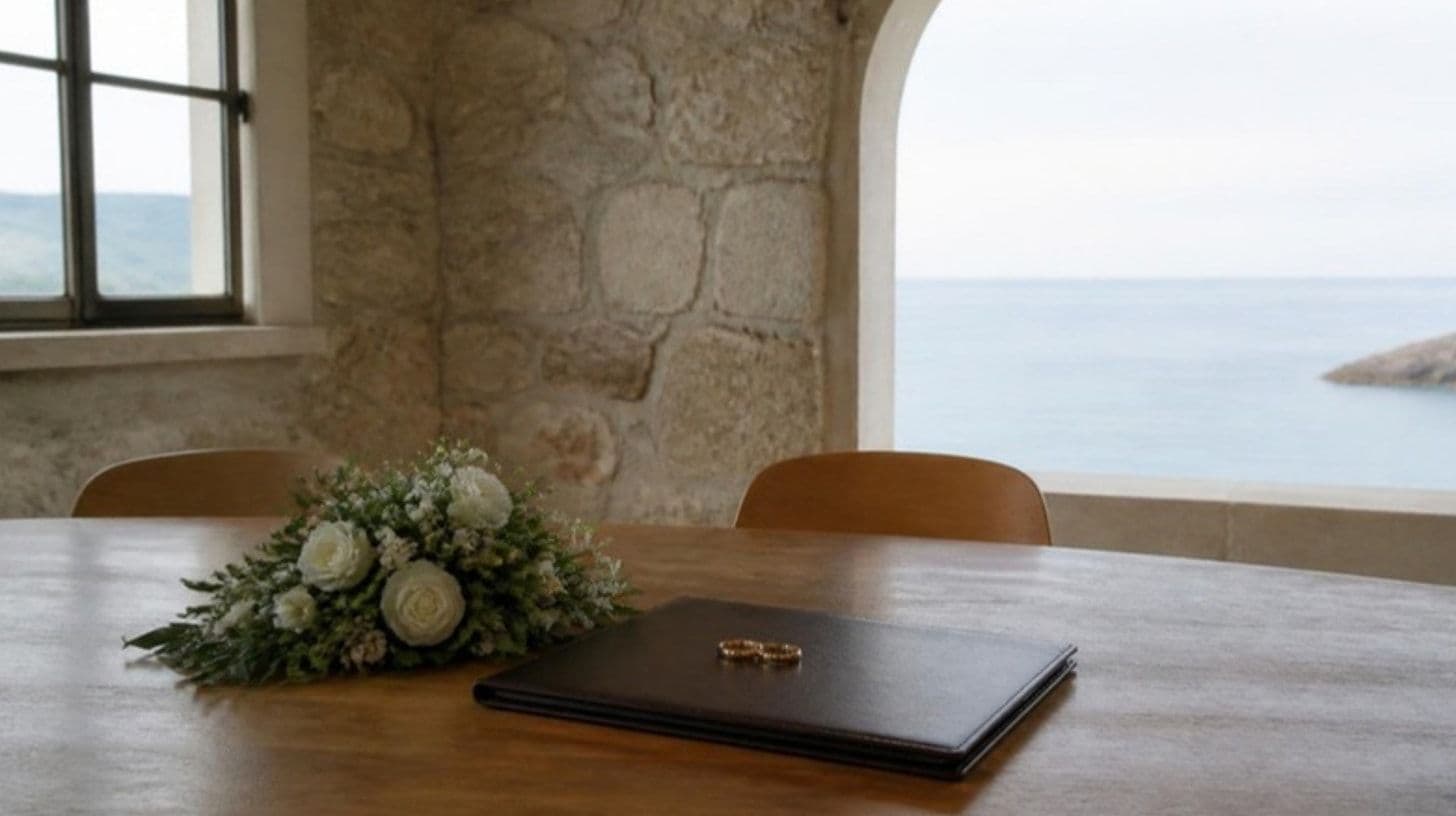
Foreigners can get married in Montenegro, including when both partners are foreign citizens. The marriage takes place at the municipality, before the registrar and a council member, with two witnesses, and with the application a foreigner files a birth certificate and proof of single status, in the original, with an apostille where required and translated by a court interpreter. In Podgorica the application is filed at least 15 days before the wedding, and the fee is 20 euros in the official hall and 100 euros at another venue.
The rules come from the Family Law and the Law on Private International Law, and the list of documents is published by the municipality where you marry. This guide explains who can marry, which documents you need, how the procedure runs, what it costs and what marriage means for residence and citizenship.
Can foreigners get married in Montenegro?
Yes. The conditions for marriage are governed, for each future spouse, by the law of the country of which that person is a citizen, and the form of the marriage by the law of the country where it is concluded, which is Montenegrin law. In practice the registrar checks whether you meet the conditions under your own country's law, and the wedding follows Montenegrin rules.
Under Montenegrin law the following cannot marry:
- a person under 18, unless a court allows a child over 16 to marry;
- a person who is already married;
- a person whose will is not free or who lacks the capacity to reason;
- close blood relatives and relatives by adoption.
The marriage must be concluded before the competent authority. A marriage not concluded before the competent authority is void, so a church ceremony alone has no effect as a civil marriage. Under the Family Law marriage is a union of a man and a woman, and a same-sex life partnership is governed by a separate law.
Which documents does the registrar ask for?
The list for foreigners published by the Capital City of Podgorica:
| Document | Note |
| Birth certificate | From the place of birth, original and court interpreter's translation |
| Certificate or other proof of single status | No older than 3 months on the wedding day, original and translation |
| Passport or ID card | Photocopy, original shown |
| Proof of registered residence | For the foreign citizen |
| Certificate that no criminal proceedings are pending in the country of citizenship | No older than one month, original and translation |
| Witnesses' documents | Photocopy of ID card or passport |
| Proof of fee payment | 20 euros in the official hall, 100 euros at another venue |
The birth certificate and the certificate of single status are apostilled in the country that issued them, unless that country has agreed with Montenegro to waive legalisation. If you do not speak the official language, you file the application and marry with a court interpreter. How an apostille is obtained and how long it is valid is explained in our article on powers of attorney from abroad and the apostille.
Other municipalities publish their own lists and fees, so check the requirements with the registrar in the municipality where you marry before gathering documents.
How does the procedure work, step by step?
- Application. The future spouses file an application with the registrar, in Podgorica at least 15 days before the wedding; in justified cases the period can be shorter.
- Check. Based on statements and documents, the registrar establishes whether the conditions are met. If they are not, the registrar says so orally and within 3 days issues a decision rejecting the application, against which an appeal is filed within 8 days, and the appeal is decided within 5 days.
- Date. The registrar sets the day and time of the wedding in agreement with you.
- Wedding. Both future spouses, a municipal council member, two witnesses and the registrar attend. Any person with legal capacity can be a witness, including a foreigner.
- Certificate. The marriage is entered in the register of marriages, and you receive the marriage certificate immediately after the wedding.
If one or both future spouses do not appear at the agreed time and do not justify the absence, the application is considered withdrawn.
Example: a wedding in Podgorica on 20 June
A couple, one a German citizen and the other a Turkish citizen, want to marry in Podgorica on 20 June:
| Step | When |
| Application to the registrar | By 5 June at the latest |
| Certificate of single status | Issued no earlier than 20 March, because it must not be older than 3 months on the wedding day |
| Apostille and translation | Before filing the application |
| Fee | 20 euros for the hall, 100 euros for another venue |
What does it cost and where can you marry?
The marriage is concluded in a ceremonial way, in an official room arranged for that purpose. The registrar can allow the marriage to take place at another suitable venue if you request it and give justified reasons. In Podgorica the administrative fee is 20 euros for a wedding in the official hall and 100 euros for a wedding at another venue, and weddings are also scheduled at weekends, until 19:30. Translation, apostille and interpreter costs are paid separately. Wedding planners, decoration and flowers can also be found through the Glatko platform.
What if one of you cannot attend?
In particularly justified cases the municipality can allow the marriage to be concluded in the presence of one future spouse and a proxy for the other. The power of attorney must be certified and issued solely for the marriage, with the personal details of the proxy and of the person being married through the proxy, and it is valid for 90 days from certification.
Which surname do you use after the wedding?
When you marry you can agree that each keeps their own surname, that both take the surname of one of you, that you take both surnames, or that only one of you adds the other's surname to their own. When one spouse is a foreigner, you can also choose the surname under the law of the country of which one of you is a citizen.
Does marriage bring residence or citizenship?
Marriage does not by itself grant residence or citizenship; each requires a separate application.
- Residence. The spouse of a Montenegrin citizen, or of a foreigner with permanent or temporary residence, can obtain a temporary residence permit for family reunification. The permit is issued for up to one year, or until the permit of the spouse being joined expires. Since the 2026 amendments the spouse of a Montenegrin citizen does not have to prove means of subsistence, but still needs health insurance. The permit is refused if the marriage is found to be one of convenience, concluded only for residence.
- Citizenship. The spouse of a Montenegrin citizen can apply for naturalisation after at least 3 years of marriage and at least 5 years of lawful, continuous residence in Montenegro, subject to conditions on age, housing and income, a clean record and security.
The 2026 amendment that also covers life partners is analysed by the law firm RoNa Legal. Registering your address, which the registrar asks for with the marriage application, is described in our guide to the first 90 days in Montenegro.
Property the spouses acquire through work during the marriage is their joint property, and a marriage contract signed before a notary can arrange things differently; how that property is divided is explained in our article on dividing property after divorce.
Checklist before the wedding
| Check | Why |
| List of documents in the municipality of the wedding | Municipalities publish their own requirements and fees |
| Issue date of the certificate of single status | It must not be older than 3 months on the wedding day |
| Apostille and court interpreter's translation | They are required for foreign documents |
| Registered residence | Required for the foreign citizen |
| Interpreter at the wedding | Mandatory if you do not speak the official language |
| Two witnesses with documents | Without them the marriage cannot be concluded |
Frequently asked questions
Can two foreigners get married in Montenegro? Yes. The registrar assesses the conditions for marriage under the law of the country of which each of you is a citizen, and the wedding follows Montenegrin rules.
Is a church wedding in Montenegro a valid marriage? Not as a civil marriage. A marriage not concluded before the competent authority is void, so the marriage is concluded before the registrar.
How far ahead do you file the marriage application? In Podgorica at least 15 days before the wedding, and in justified cases the period can be shorter. Other municipalities may have their own rules.
How much does a municipal wedding cost? In Podgorica the fee is 20 euros for a wedding in the official hall and 100 euros for a wedding at another venue. Translation, apostille and interpreter are paid separately.
Can you marry by proxy? In particularly justified cases, yes. The power of attorney must be certified, issued solely for the marriage, and it is valid for 90 days from certification.
Does marrying a Montenegrin citizen bring citizenship? Not automatically. An application for naturalisation can be filed after at least 3 years of marriage and 5 years of lawful, continuous residence, subject to the other statutory conditions.
Sources
The conditions and procedure for marriage are set by the Family Law (Official Gazette of the Republic of Montenegro 1/2007 and Official Gazette of Montenegro 53/2016 and 76/2020, articles 15 to 38 and 41), the applicable law by the Law on Private International Law (Official Gazette of Montenegro 1/2014, articles 17, 77 and 78), residence for family reunification by the Law on Foreigners (Official Gazette of Montenegro 12/2018, 3/2019, 86/2022, 77/2024 and 3/2026, articles 43 to 46), and naturalisation by the Law on Montenegrin Citizenship (Official Gazette of Montenegro 13/2008, 40/2010, 28/2011, 46/2011, 20/2014, 54/2016, 73/2019, 77/2024 and 119/2026, articles 8 and 11). The list of documents, the 15-day period and the fees are published by the Capital City of Podgorica in its Internal Procedure of 5 December 2024. The rules were checked on 24 September 2026. Fijaka is a classifieds platform and does not provide legal advice; for a specific case, contact the registrar or a lawyer.