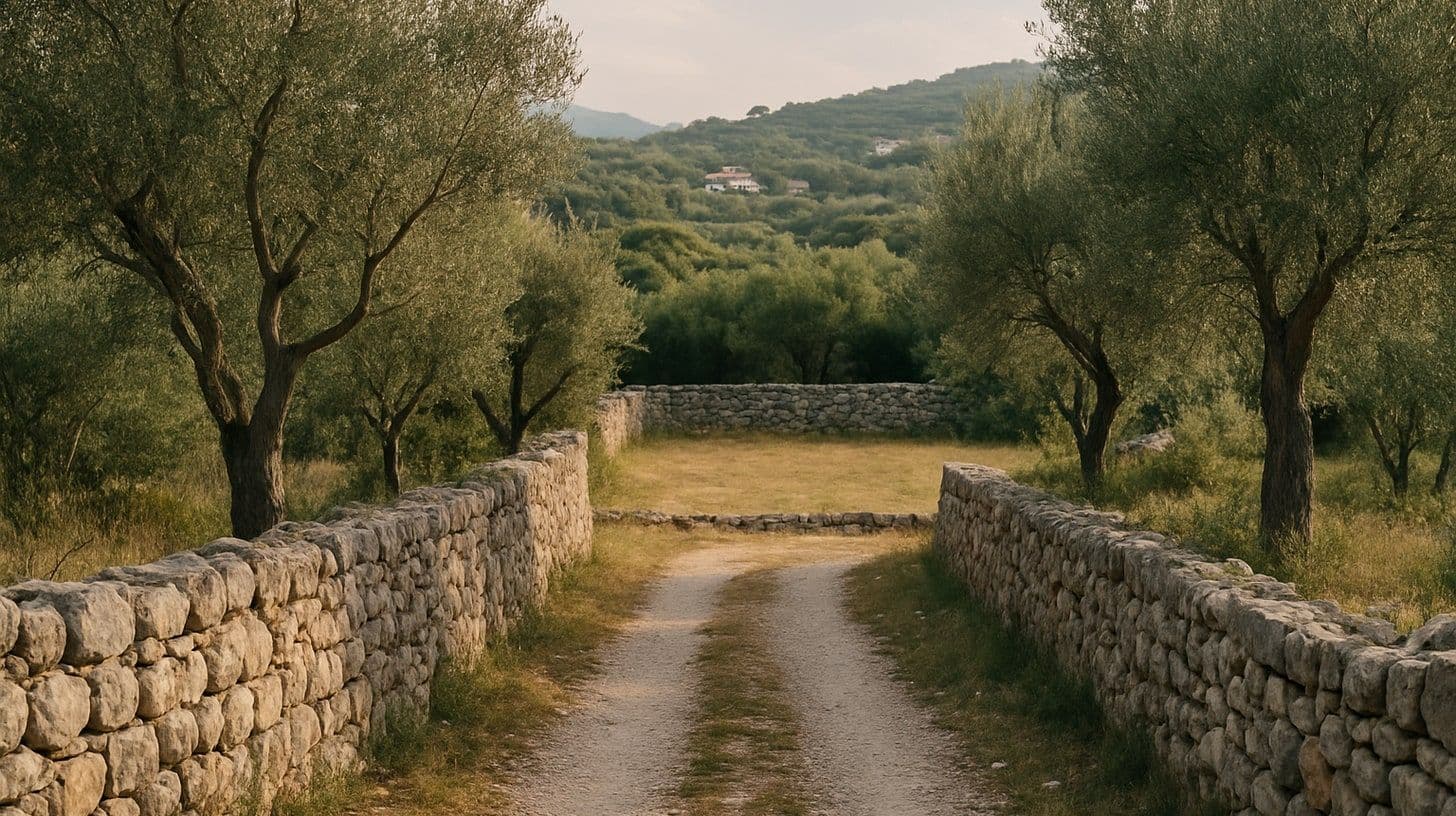
How is a right of way registered? On the basis of a written, certified contract, for which the Law on Notaries requires the form of a notarial deed, or of a final court decision. It is entered on sheet G, as a right of the dominant property and a burden on the servient property, with a sketch if the passage is spatially limited.
Local searches show what people want to know about a right of way: "pravo služnosti" (easement) is followed by "puta" (of a road), "prolaza i provoza" (for walking and driving), "primjer" (example) and "zakon" (law), and "služnost prolaza" (right of passage) by "nužnog prolaza" (of necessity), "kolnog prolaza" (for vehicles), "kroz tuđu nekretninu" (through someone else's property) and "naknada" (compensation). "Služnost" is the everyday word; Montenegro's Law on Property Relations calls the same right a real servitude (stvarna službenost).
This article explains what a right of way is, the three ways it arises, what an access of necessity is, how it is registered in the cadastre, when it ends and what to check before buying a plot that is reached across someone else's land.
What a real servitude is
A real servitude is the right of the owner of one property to carry out certain acts on another owner's property for the needs of the first, or to require the other owner to refrain from certain acts. The law uses two terms that recur in every contract and judgment:
| Term | Meaning |
| Dominant property | The property that benefits from the servitude, for example your plot |
| Servient property | The property that bears the servitude, for example the neighbouring plot you cross |
Servitudes can be real or personal. Personal servitudes are usufruct, the right of use and the right of residence, and they are tied to a person, not to a property. A right of way is a typical real servitude: it belongs to whoever owns the dominant property, so it passes to a buyer as well.
A servitude is exercised in the way that burdens the servient property least. New needs of the dominant property that do not follow from its normal development do not widen the servitude. If the servitude is exercised on one part of the servient property, its owner may ask, at their own cost, for the passage to be moved to another place on the same property, provided this does not make it harder to use. The cost of maintaining a road or installation needed for the servitude is borne by the owner of the dominant property; if the road also serves the owner of the servient property, the two share costs in proportion to their benefit.
Three ways a servitude is created
| Way | How it arises | What to watch |
| Contract | On entry in the cadastre | The contract must be in writing and certified; the Law on Notaries requires a notarial deed for transactions acquiring real rights in real estate |
| Decision of a court or other state body | On the day the decision becomes final | Issued when the owner of the dominant property cannot use it without using someone else's |
| Prescription | When the statutory period runs out | Only for visible servitudes; effective against a third party acting in good faith only from entry in the cadastre |
An owner of two properties can also burden one of them with a servitude in favour of the other, which is useful before selling one of two neighbouring plots.
Prescription periods
| Situation | Period |
| The owner of the dominant property actually exercised the servitude and the owner of the servient property did not object | 20 years |
| Holder of the servitude in good faith and on a lawful basis | 10 years |
| Possession in good faith | 15 years |
A servitude cannot be acquired by prescription if it was exercised by force, by fraud, by abuse of the owner's trust, or if it was granted until revoked. A servitude is visible if an outward sign accompanies it, such as a trodden path or a gate in a wall. Once acquired by prescription, a servitude can be asserted against a third party in good faith only from its entry in the cadastre, so registration matters even after the period has run.
Access of necessity
The owner of a property that has no access to a public road, or can reach one only by an excessive detour, is entitled to ask for passage over someone else's land against payment of compensation. The law calls such a plot enclosed land or an enclave.
- Scope. An access of necessity can be granted for pedestrians, carts, motor vehicles and farm machinery.
- Enclave created by division. If the plot lost its access because a larger plot was divided, passage can be allowed only over land that formed a whole with it before the division.
- House and yard. An access of necessity cannot be established across a house and yard, unless there is no other way out to a public road.
- New public road. If a new public road is built or the reasons for the passage cease, the owner of the burdened land can ask for it to be abolished, returning part of the compensation received as assessed by the court.
- Buy-out. The owner of the burdened land can ask the holder of the right to buy the part of the land used for the passage.
The law separately regulates utility lines: a landowner must, against compensation, allow water and sewage pipes, cables and poles to be laid on their land if laying them elsewhere would cost disproportionately more.
Compensation
The owner of the servient property is entitled to compensation for an established servitude. The law does not set an amount. If the owners do not agree, the court fixes it at the request of the owner of the servient property, taking all circumstances into account, in particular lost profit and the reduced value of the servient property.
Entry in the cadastre
Rights in real estate are acquired, transferred, limited and extinguished by entry in the real estate cadastre, unless the law provides otherwise. Real servitudes are entered on sheet G of the title extract, as a right of the owner of the dominant property and as a burden on the servient property. They are entered with the content and scope of the right, without a monetary value. When a servitude is spatially limited, for example to a strip the width of a track, its boundaries count as precisely defined if they are drawn on a sketch attached to the document submitted for registration. How to read sheet G is explained in our article on the title extract.
When a servitude ends
| Reason | Condition |
| Non-use despite objection | The owner of the servient property objects and the owner of the dominant property does not exercise the right for three consecutive years |
| Non-use | The servitude is not exercised for the period needed to acquire it by prescription |
| Same owner | One person becomes the owner of both properties |
| No longer needed | The servitude becomes unnecessary for using the dominant property |
| Changed circumstances | The benefit to the dominant property becomes disproportionate to the burden; abolition against fair compensation |
| Destruction | Exercise becomes permanently impossible; if the servient property is restored within five years, the servitude returns in its former scope |
| Expiry | A servitude established for a fixed period |
When the dominant property is divided, the servitude remains in favour of all parts, but the owner of the servient property can ask for it to end for a part it does not serve.
What to check before buying a plot
A visible track to a plot is not the same as a registered right of way. The Law on Spatial Development requires an urban plot to have secured vehicle access from a city street or public road, in line with the planning document; only in old town centres and on difficult terrain with existing buildings is pedestrian or bicycle access enough. How to check a plot from land class to permit is explained in our article on buying land to build a house.
| Check | Why |
| Sheet G of your plot | Whether the right of way is entered as a right in favour of the plot |
| Sheet G of the neighbouring plot | Whether the same servitude is entered as a burden |
| Sketch with the servitude contract | The width and route of the passage must be precisely defined |
| Whether the road is public or on a private plot | A public road needs no servitude |
| Who maintains the road | The owner of the dominant property bears the cost, unless the road also serves the other |
| Purchase contract | It should mention the registered servitude and the sketch |
Other checks before signing are listed in our article on whether buying property in Montenegro is safe, and the notary stage in our article on the purchase contract. You can post or find plots and houses in our real estate category.
Frequently asked questions
Is "služnost" the same as "službenost"? Yes. Montenegrin law uses the term real servitude (stvarna službenost); služnost is the everyday word for the same right.
What is an access of necessity? The right of the owner of a plot without access to a public road to ask, against compensation, for passage over someone else's land. It cannot be established across a house and yard, unless there is no other way out.
How much is compensation for a right of way? The law does not set an amount. The owners can agree it, and if they do not, the court sets compensation based on lost profit and the reduced value of the servient property.
Can a right of way be acquired by prescription? Yes, if it is visible. The period is 20 years of actual use without objection from the owner, 10 years for a holder in good faith and on a lawful basis, and 15 years for possession in good faith.
Does a right of way pass to the new owner of the plot? Yes. A real servitude belongs to every owner of the dominant property and burdens every owner of the servient property.
Sources
Servitudes, access of necessity, compensation and termination are governed by the Law on Property Relations (Official Gazette of Montenegro 19/2009 and 29/2025, articles 193 to 216 and 222); the 2025 amendment does not touch the servitude provisions. Registration is governed by the Law on State Survey and Real Estate Cadastre (Official Gazette of the Republic of Montenegro 29/2007 and Official Gazette of Montenegro 32/2011, 40/2011, 43/2015, 37/2017, 17/2018 and 160/2025, articles 8, 53, 78 and 79), the notarial deed form by the Law on Notaries (article 52), and vehicle access to an urban plot by the Law on Spatial Development (Official Gazette of Montenegro 19/2025, article 59). Fijaka is a listings platform and does not give legal advice; for a specific passage, check the title extract and contact a notary.