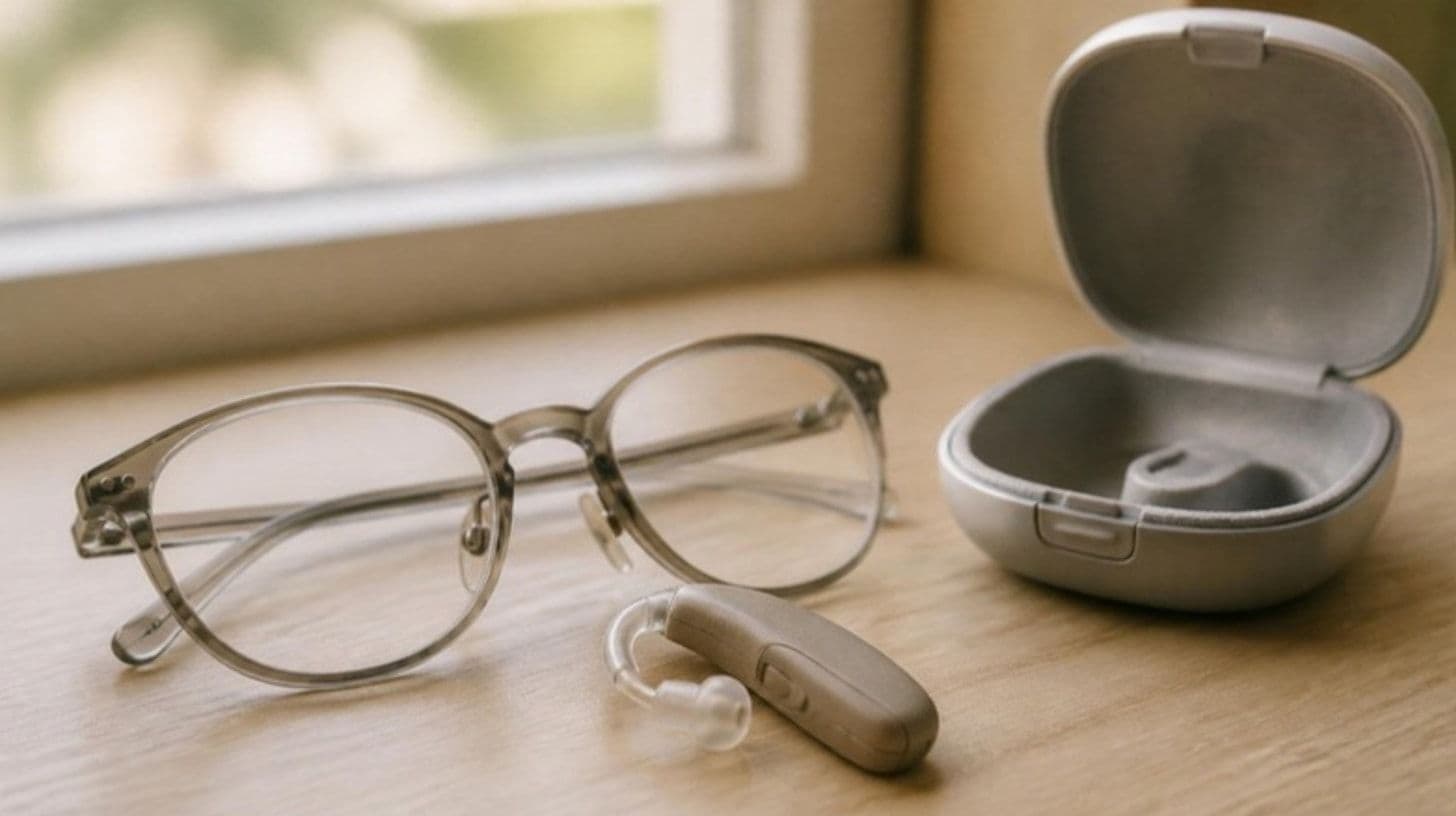
The Health Insurance Fund provides glasses, contact lenses and hearing aids as medical devices, on the proposal of an ophthalmologist or of a panel of an audiologist and ear, nose and throat specialists. Glasses can be obtained every 12 months up to age 18, every 24 months from 18 to 65 and every 36 months after 65. Children receive plastic corrective lenses regardless of the prescription, adults from +3 or -3 dioptres. Children receive a hearing aid with bilateral hearing loss of 30%, adults from 40%. The aid is collected from a contracted supplier with the Fund's approval.
This guide explains which eye and hearing aids the Fund pays for, the conditions for children and adults, how often the aid is renewed, how the procedure works and where you collect the aid.
Which eye aids does the Fund pay for?
- Glasses with mineral or plastic corrective lenses, cylindrical, bifocal or lenticular, and tinted lenses without a prescription, with a frame.
- Semi-rigid, soft, therapeutic and scleral contact lenses, in line with the List of aids; anyone who receives lenses is also entitled to glasses.
- Telescopic glasses for a person with severe low vision whom ordinary lenses do not help, on the proposal of a panel of ophthalmologists at the Clinical Centre of Montenegro.
When are you entitled to glasses?
| Lenses | Condition |
| Mineral corrective lenses | long-sightedness, short-sightedness or age-related long-sightedness; cylindrical for astigmatism |
| Plastic corrective lenses, up to age 18 | long- or short-sightedness regardless of prescription, and after cataract surgery |
| Plastic corrective lenses, over 18 | long-sightedness or age-related long-sightedness above +3 dioptres, short-sightedness from -3 dioptres, and after cataract surgery |
| Plastic cylindrical lenses, over 18 | the same conditions plus astigmatism above 2 dioptres |
| Lenticular lenses | after cataract surgery, long-sightedness above +9 and short-sightedness above -9 dioptres |
How often do you get new glasses?
| Age | Frame and lenses |
| Up to 7 | every 12 months |
| 7 to 18 | every 12 months |
| 18 to 65 | every 24 months |
| Over 65 | every 36 months |
- You get new lenses or contact lenses before the period ends if your prescription changes by 0.50 dioptres.
- The period runs from the date the approval certificate is issued.
When are you entitled to a hearing aid?
| Who | Condition | How often |
| Child under 18 | bilateral hearing loss of 30%: one behind-the-ear digital aid; loss of 45 dB in at least two speech frequencies: two aids | up to 7 every 24 months, 7 to 18 every 36 months |
| Adult over 18 | bilateral hearing loss of 40%: one basic behind-the-ear digital aid, or two if the person previously used the children's model | every 60 months |
- A child can exceptionally be granted one aid with a loss of 40 dB in the speech range.
- Children and young people aged 12 months to 20 years with complete bilateral hearing loss or a loss of 90 dB are granted a cochlear implant.
- The proposal for a hearing aid is made by a panel of an audiologist or surdo-audiologist and two ear, nose and throat specialists, and the Fund approves the aid.
How does the procedure work?
- An examination by an ophthalmologist or the panel, with medical records no older than six months.
- The doctor issues a proposal for the aid, valid for 60 days.
- On the basis of the proposal the Fund issues an approval certificate, also valid for 60 days.
- With the certificate you collect the aid from a contracted supplier: the Fund has contracts with 21 opticians and five hearing aid suppliers.
- The supplier delivers within 30 days, or 60 days for a custom-made aid; if it does not, you can buy it from another supplier and the Fund reimburses up to its own price.
- The price includes trial, fitting, training and servicing during the warranty period.
- If you want a frame or lenses in a different material or with other features, the supplier can make them and you pay the difference.
- If the aid does not work properly, within 60 days of collection you can ask a Fund commission to assess it.
- The law provides for a co-payment on aids, set by the Government, and children, pregnant women and new mothers and people over 65, among others, are exempt.
Dental care through the Fund is explained in our guide to the dentist through the Fund, and choosing a doctor in our guide to the chosen doctor. Insurance for foreigners is covered in our guide to health insurance, and the disability allowance in our guide to the disability allowance.
Frequently asked questions
How often does the Fund provide glasses? Every 12 months up to age 18, every 24 months from 18 to 65, and every 36 months after 65.
From what prescription does the Fund pay for adults' glasses? For plastic lenses from +3 dioptres for long-sightedness and age-related long-sightedness and from -3 dioptres for short-sightedness, and for children regardless of prescription.
When does the Fund pay for a hearing aid? For children with bilateral hearing loss of 30% or 45 dB, and for adults with bilateral hearing loss of 40%.
How often do you get a new hearing aid? Children up to 7 every 24 months, 7 to 18 every 36 months, and adults every 60 months.
Where do you collect glasses through the Fund? From an optician contracted with the Fund, with the Fund's approval certificate, which is valid for 60 days.
Can I choose a more expensive frame or lenses? Yes, if the supplier makes the aid in a different material, and you pay the price difference yourself.
Sources
The types of aids, conditions, periods of use and procedure are set by the Rulebook on the right to medical devices (Articles 12 to 17, 30 to 36 and 57 to 69, with the List of aids), Official Gazette 93/2023, as amended by the October 2024 rulebook. The right to aids and the co-payment exemptions are governed by the Compulsory Health Insurance Act (Articles 14, 15 and 17), and the list of contracted opticians and hearing aid suppliers is published by the Health Insurance Fund. The information was checked on 27 September 2026. Fijaka is a classifieds platform; this text is not medical advice.